The Lost World of the Krymchaks of Crimea

The Matriarch Mission’s main character is a fictional young Krymchak woman. Who are these Krymchaks and why did “history” erase them?

There is a place on the tenth kilometer of the Simferopol-Feodosia highway where every year on December 11, a small group of people gather to recite Kaddish. They call the day Tkun — from the Hebrew tikkun, meaning mending, or the restoration of order. Most of them no longer speak the language their grandparents spoke. Most of them live scattered across Israel, Russia, Ukraine, and the United States, connected to each other and to this place by little more than memory and a grief that has never fully found its name. They are Krymchaks, the Jews of Crimea,and they are among the last of a people who lived on the Crimean peninsula for two thousand years.

Today there are approximately 1,200 to 2,000 Krymchaks left in the world. Five to seven of them are fluent speakers of the Krymchak language. The community that produced Oksana Mangupli — the protagonist of The Matriarch Mission — stood at roughly nine thousand people in 1941. Within months, the Nazis killed six thousand of them. The Soviet state then administratively erased the survivors: in the USSR, passports could list any ethnic nationality except Krymchak. Those who remained were recorded as Jews or Crimean Tatars. Soviet bureaucracy explained its logic plainly: we believe that if you were under occupation, then you were destroyed. And if you were destroyed, then Krymchaks no longer exist.

Oksana does not know any of this in 1922. She knows only the world that made her.

A People Shaped by Two Thousand Years of In-Between

The Krymchaks were never quite anything else. They were not Ashkenazi, not Sephardi, not Karaite, not Tatar — and yet they were, in different proportions, all of these things and more. The first Jewish communities on the Crimean peninsula arrived with Greek colonization along the Black Sea coast, possibly as early as the first century BC, and the cemetery inscriptions and slave-liberation documents they left behind mark the beginning of one of the longest continuous Jewish presences anywhere in the world.

Over the following two millennia, waves of Jewish migrants arrived and were absorbed: refugees from Byzantine persecution, merchants from Constantinople, ransomed captives of Ashkenazi origin brought to Crimea by Tatar raiders, scholars from Italy and Spain, traders from Georgia and Persia. One of the most significant arrivals was Mosheh ha-Goleh — Moses the Exile — a Talmudic scholar from Kiev who came to Crimea in the fifteenth century and spent decades reconciling the community’s divergent practices into a single unified prayer tradition. The result was the Nusah Kaffa, named for the ancient city of Kaffa — now Feodosia — which had been the community’s spiritual center for centuries. It incorporated elements of Byzantine, Sephardi, Romaniote, and Ashkenazi practice into something found nowhere else on earth.

The Krymchaks spoke Crimean Tatar as their vernacular — a Turkic language they wrote in Hebrew characters, producing texts in which the grammar and phonology were Tatar while the sacred vocabulary and syntactic structures were Hebrew and Aramaic. Their family journals, called jönk, were passed from father to eldest son, containing stories, proverbs, personal accounts, and recipes in this hybrid script. Their prayer books faced south, like a mosque, rather than east, like a synagogue. The Crimean Tatars called them zuluflu chufutlar — Jews with earlocks — to distinguish them from the Karaites next door, who were zulufsuz chufutlar — Jews without earlocks. Even the folk taxonomy that named them was comparative, relational, defined by proximity to others.

This in-between quality was not a weakness. It was the community’s genius and its survival strategy across two thousand years of changing rulers. Byzantine, Genoese, Tatar, Ottoman, Russian — each power in turn had controlled the Crimean peninsula, and the Krymchaks had navigated each transition by being flexible enough to absorb the dominant culture without dissolving into it. They dressed like Tatars, cooked like Tatars, spoke Tatar in the market and Hebrew in the synagogue, and remained recognizably, stubbornly themselves.

The World That Made Oksana

By 1922, when Oksana leaves Crimea on the expedition to the Kola Peninsula, the community she comes from is already living through its third major disruption in five years. The Civil War and the famine of 1921–22 had killed seven hundred Krymchaks. Others had emigrated to Palestine and the United States. The census of 1926 would count 6,383 Krymchaks in the Soviet Union, down from perhaps twice that number a generation earlier.

But the community was still intact in its essential structures. Traditional religious education of Krymchak children was still being conducted in the mid-1920s. The synagogues still faced south. The jönk were still being passed down. The Tkun memorial had not yet been necessary — the massacre that would make it necessary was still twenty years away.

What the community gave Oksana, before it gave her anything else, was a complete moral architecture. Duty, obedience, and honor were not abstract concepts in Krymchak life — they were lived through specific, codified relationships. The patriarchal nature of the family was preserved well into the late nineteenth century. Girls married young, often to relatives, in unions arranged by families rather than chosen by individuals. A widow could never remarry, because husband and wife were considered inseparable even after death. The family’s practice of charity was communal and obligatory: no beggars existed among them because the community ensured that the poor received firewood, flour, and candles. These were not individual acts of generosity but the discharge of collective duty.

For Oksana, this means that when her father arranges her marriage, he is not acting capriciously. He is fulfilling his role in a system of obligations that extends in every direction: to the community, to God, to the family’s honor, to her future. When she chafes against the marriage, she is not simply rebelling against one man’s decision. She is in tension with the entire architecture of meaning her world rests on. Obedience to the father is obedience to the community is obedience to God. The chain of duty is seamless and total.

And yet her baba — her grandmother — had given her something that complicated this architecture from the inside. Not a rejection of duty, but a different account of where duty ultimately comes from. The baba’s insistence on following the words of Asherah — the ancient goddess whose voice Oksana has been taught to hear, the divine feminine that predates the patriarchal structures layered over it — does not contradict Krymchak faith so much as reach beneath it. The Krymchak tradition itself carried traces of this deeper layer. Their mystical practice drew on Kabbalistic streams — the Zohar, the practical Kabbalah of Isaac Luria — in which the divine feminine, the Shekhinah, was not a marginal figure but the very presence of God in the world, the aspect of divinity that dwells among human beings and weeps when they suffer. The baba’s teaching is not heresy. It is the oldest part of the tradition made primary.

This is Oksana’s specific tension, and it is not resolvable in the terms her world provides. The Krymchak world says: obey your father, honor your husband, fulfill your role in the chain of obligation that holds the community together. The baba says: listen to the voice that speaks beneath all those obligations, the voice that was there before your father and will be there after. When those two authorities align — when her father’s demand and the deeper voice say the same thing — Oksana can act without conflict. When they diverge — when duty requires what the deeper voice refuses, or when the deeper voice calls her somewhere duty does not permit — she is in the territory the novel inhabits.

The Language of Honor

What made Krymchak obedience different from simple submission was that it was mutual and covenantal. The kitubu — the marriage contract entered before the wedding — specified not only the wife’s obligations but the husband’s, and included a bail the man’s family would forfeit in case of divorce. This was not sentimentality. It was contract law. The chain of obligation ran in both directions: the husband owed the wife as much as she owed him, the father owed the daughter as much as she owed the father. Honor was not simply what women owed men. It was what everyone owed everyone, in a community small and tight enough that every defaulted obligation was visible.

Oksana’s problem with Yuri is not only that he is cruel, though he is. It is that he has broken the covenant. He has taken what the contract promised him and given nothing in return. In Krymchak terms, this is not merely personal failure — it is a violation of the order that holds everything together. Her suffering is real and particular, but its meaning in her framework is structural: a man who does not honor his obligations has severed himself from the web of mutual duty that makes community possible. That Oksana stays as long as she does is not weakness. It is the Krymchak moral logic working exactly as designed — the system asks her to absorb the failure of others rather than let the community fracture.

That she eventually leaves, that she finds her way north and then further north toward something the Krymchak world has no category for, is the novel’s central movement. She does not leave because she has stopped believing in duty and honor. She leaves because the baba’s voice finally tells her that the duty she owes the deepest thing in herself has become incompatible with the duties her community demands. That is a different kind of obedience — not less demanding but more absolute.

What Was Lost

The community Oksana came from does not survive the twentieth century intact. The Nazis debated whether Krymchaks qualified as Jews. The SS carried out formal research into the community’s background before reaching their conclusion. The delay between the roundups of Ashkenazi Jews and Krymchaks in each Crimean city — twelve days in Feodosia, forty-five days in Karasu-Bazar — was the interval in which Krymchaks watched their neighbors being taken and understood what was coming. Bakhchisarai, December 13, 1941: ninety Krymchaks killed. Simferopol, December 9: fifteen hundred. Kerch, December 1–3: an entire city’s Jewish population including all its Krymchaks. Feodosia, November 17: gas vans.

Those who survived the Holocaust were then required by Soviet bureaucracy to stop existing as Krymchaks. Their passports listed them as Jews or Tatars. The category was erased. The jönk — those family journals in Hebrew-Tatar script passed from father to son — stopped being produced. The language, which had already lost most of its speakers, lost the rest. By 2001, fewer than 785 Krymchaks remained in Crimea. Worldwide today: perhaps 1,200 to 2,000, most of them in Israel and Russia, most of them Russian-speaking, most of them connected to the tradition by little more than memory and the annual gathering at the tenth kilometer of the Simferopol-Feodosia highway.

Five to seven fluent speakers of the Krymchak language remain alive in the world.

The word the survivors chose for their memorial day is Tkun — tikkun — mending. The repair of what has been broken. It is a Kabbalistic concept: the idea that the divine light shattered at the moment of creation, and that human acts of justice and compassion gather the scattered sparks and restore what was lost. The baba would have understood it. It is, in its way, exactly what Asherah asked Oksana to do.

The Matriarch Mission is set in 1922, before any of this destruction. But Oksana carries the world that will be lost — its obligations, its languages, its covenantal understanding of honor, the baba’s deeper teaching running beneath it all. She does not know she is among the last generation who will know this world fully from the inside. The reader does.


References and Further Reading

The following sources corroborate the historical claims in this account. Where primary documentation is limited, the most authoritative available scholarship is indicated.

Primary Encyclopedic and Scholarly Sources

“Krimchaks.” Encyclopaedia Judaica. Jerusalem: Keter Publishing, 1972. Reprinted in Jewish Virtual Library. The foundational English-language scholarly entry on the community, covering demography, history, religious tradition, and the Holocaust. jewishvirtuallibrary.org/krimchaks

Zand, Michael. “Krymchaks.” In Gershon David Hundert, ed., The YIVO Encyclopedia of Jews in Eastern Europe, vol. 1. New York: YIVO Institute for Jewish Research / Yale University Press, 2008, pp. 948–951. The authoritative scholarly treatment in English, drawing on Russian, Hebrew, and Krymchak-language primary sources. encyclopedia.yivo.org/article/91

Achkinazi, Igor Veniaminovich. Krymchaki: Istoriko-etnograficheskii ocherk [The Krymchaks: A Historical-Ethnographic Study]. Simferopol, 2000. The primary Russian-language monograph on Krymchak history and ethnography. The foundational source for most subsequent scholarship on the community.

Khazanov, Anatoly. The Krymchaks: A Vanishing Group in the Soviet Union. Jerusalem: The Marjorie Mayrock Center for Soviet and East European Research, Hebrew University of Jerusalem, 1989. Documents the community’s Soviet-era demographic decline and the administrative erasure of the Krymchak ethnic category.


On the Holocaust of the Krymchaks

Spector, Shmuel. “Sho’at hayehudim hakrimchakim bitkufat hakibbush hanatzi” [The Holocaust of the Krymchak Jews During the Nazi Occupation]. Pe’amim 27 (1986): 18–27. Hebrew-language study of the systematic killing of the Krymchak community by Einsatzgruppe D.

Loewenthal, Rudolf. “The Extinction of the Krymchaks in World War 2.” The American Slavic and East European Review 10 (1951). Early English-language documentation of the destruction of the community.

“The Holocaust of the Krymchaks.” Yad Vashem — The World Holocaust Remembrance Center. Draws on Achkinazi, Spector, and Loewenthal to document the SS research into Krymchak classification, the timeline of killings across Crimean cities, and community population calculations. yadvashem.org/research/about/mirilashvili-center/articles/holocaust-krymchaks.html


On Krymchak Language and Written Culture

“Krymchak.” Jewish Languages Project. Harvard University. Documents the hybrid Hebrew-Tatar script, the jönk family journal tradition, liturgical texts including the 1904 Haggadah, and the language’s current near-extinction. jewishlanguages.org/krymchak

“Krymchak Language.” Wikipedia. Sourced survey drawing on linguistic scholarship, documenting the community’s demographics by decade from 1897 through 2001, the impact of the 1944 Tatar deportation on Krymchak language survival, and the current estimate of five to seven fluent speakers worldwide. en.wikipedia.org/wiki/Krymchak_language


On Community Identity and Soviet-Era History

“Krymchaks.” Encyclopedia.com, drawing on the Encyclopedia of World Cultures. Documents the Soviet administrative erasure of the Krymchak ethnic category, the post-war pressure to adopt a non-Jewish ethnic origin myth, and the community’s material culture and marriage traditions. encyclopedia.com/humanities/encyclopedias-almanacs-transcripts-and-maps/krymchaks

“Krymchaks.” Wikipedia. Synthesized scholarly entry covering origins, language, religious tradition, Holocaust, and current population. Notes the 2000 population estimate of approximately 600 in the former Soviet Union and 600–700 maintaining Crimean identity in Israel. en.wikipedia.org/wiki/Krymchaks


On the Living Community

Lombroso, Viacheslav, interviewed in: “Krymchaks of Ukraine. Who Are They?” Ukraїner, June 2023. The most detailed recent English-language profile of a living Krymchak, documenting the Tkun memorial, the community’s response to the 2014 Russian occupation of Crimea, the Soviet passport erasure, and contemporary preservation efforts. ukrainer.net/en/krymchaks/

“Krymchaks. Who Are They?” Crimean Tatar Resource Center, 2023. Documents current world population estimate of approximately 1,200. Includes note on American film director Ralph Bakshi as a notable Krymchak descendant. ctrcenter.org/en/krymchaks-who-are-they

“Indigenous Peoples in Ukraine You May Have Never Heard About.” UkraineWorld, 2021. Places the Krymchaks within Ukraine’s indigenous peoples framework alongside Crimean Tatars and Karaites. Notes the unique orientation of the Krymchak synagogue facing south rather than east. ukraineworld.org/en/articles/opinions/indigenous-peoples-ukraine-you-may-have-never-heard-about


On the Tkun Memorial and Language Extinction

The memorial day observed on December 11 each year at the tenth kilometer of the Simferopol-Feodosia highway is documented in the Ukraїner profile above and in the Jewish Languages Project entry. The word Tkun — from the Hebrew tikkun, meaning mending or restoration — and its significance as one of the last Krymchak words in active use is noted in the Jewish Languages Project documentation of post-Holocaust memorial poetry.

The 2001 Ukrainian census figure of fewer than 785 Krymchaks remaining in Crimea is sourced to the Krymchak Language Wikipedia entry, which draws on Ukrainian state census data. The estimate of five to seven fluent speakers worldwide is from the same source.


Note on Source Limitations

The most substantive primary scholarship on the Krymchaks — Achkinazi’s 2000 monograph, Spector’s 1986 study, Moskovicz and Tukan’s 1982 Hebrew-language community history in Pe’amim 14 — exists primarily in Russian, Hebrew, and Krymchak, with limited English translation. The English-language sources cited above draw on this scholarship. Readers seeking the deepest primary documentation are directed to the YIVO Encyclopedia entry, which provides the most complete bibliography of the available scholarship across languages.


Alexander Barchenko Who?

Soviet Scientist, Occultist, and Seeker of the Ancient World

Alexander Vasilyevich Barchenko was born on March 25, 1881, in Yelets, a provincial city in what is now Lipetsk Oblast in central Russia. His father was a sworn attorney and notary of the district court — a man of rational, legal temperament whose son would spend his life pursuing precisely the opposite of rational certainty. His mother came from the clergy. It was perhaps this tension between law and faith that shaped Barchenko’s lifelong attempt to reconcile science with the sacred.

He enrolled in the medical faculty at Kazan University in 1904, one of the finest psychiatric schools in Russia at the time, then transferred to Yuryev University in what is now Tartu, Estonia. He never completed his degree. Lack of funds was the official reason, but by this point Barchenko had found a more consuming education: the esoteric traditions of Western and Asian mysticism, introduced to him by a professor of Roman jurisprudence named Krivtsov who shared with his students the teachings of the French mystic Saint-Yves d’Alveydre. From this introduction, Barchenko absorbed the idea that ancient civilization had once possessed a unified body of scientific and spiritual knowledge — a primordial science — that had been lost to the modern world but survived in fragments in Tibet, in Sami shamanism, in Sufi tradition, in Kalachakra tantra. The rest of his life was an attempt to recover it.

The Silver Age Context

It would be a mistake to read Barchenko as a fringe figure. He worked in an era and a cultural milieu in which the boundary between serious science and esoteric inquiry was genuinely porous. Dmitry Mendeleev, creator of the periodic table, was a committed student of spiritualist practices. Vladimir Bekhterev, the most prominent neurologist and psychiatrist in Russia, conducted formal research into what he called invisible brain waves through experiments with mediums. The philosophers Pavel Florensky and Vladimir Solovyov, the writers Mikhail Bulgakov and Andrei Bely, the composer Alexander Scriabin, the artist Wassily Kandinsky — mysticism and occultism ran through the heart of Russian intellectual culture in the Silver Age. Helena Blavatsky and George Gurdjieff, both products of the Russian Empire, were recognized as the most influential occultists in the world.

Barchenko earned his place in this world on his own terms. Between 1909 and 1917 he wrote prolifically for Russian periodicals on occult subjects, published science fiction novels that explored consciousness, ancient civilizations, and psychic phenomena, and established a reputation as a researcher of genuine range. His 1913 novel Doctor Black drew on Theosophist ideas absorbed through his university contacts. His 1914 Out of the Darkness extended this fictional exploration of esoteric themes into territory that anticipated later Soviet-era parapsychology. In 1911, he gave public demonstrations of telepathy and telekinesis using apparatus he had constructed himself: copper helmets connected by wire to test thought transmission between subjects in separate rooms, and a cotton fiber suspended on a needle inside an evacuated glass vessel that he claimed to rotate by concentrated thought. Whether or not these demonstrations proved what he claimed, they drew serious audiences and serious attention.

The Bolshevik Bargain

The 1917 Revolution did not end Barchenko’s career — it transformed it. The new Soviet state was officially committed to scientific materialism and the elimination of religion, but within the secret police apparatus a different logic was operating. If psychic phenomena were real, they were weapons. If ancient civilizations had possessed advanced forms of mental technology, the Soviet state needed them before the capitalists developed an equivalent.

The critical introduction came in 1918. Yakov Blumkin — Trotsky’s head of personal security, a man who had recently assassinated the German Ambassador Count von Mirbach, and who would later disguise himself as a Tibetan lama on a covert mission into Central Asia — brought Barchenko together with Bekhterev and with Gleb Bokii, the man who would become head of the OGPU’s Special Department. All four men, it emerged, shared an interest in occult phenomena and a conviction that esoteric knowledge could be pressed into state service. In 1921, Felix Dzerzhinsky — Lenin’s feared security chief, an atheist to his core — signed the resolution creating a special department under the OGPU. For cover it was designated a cryptographic unit. Its real mandate encompassed telepathy, mass hypnosis, shamanic practices, and the investigation of anomalous phenomena.

Bokii headed the department. Barchenko was his deputy for scientific research. The budget was extraordinary: individual operations cost the equivalent of roughly $600,000 in today’s terms. Over the fifteen years of the department’s existence, it was refused funding only once. Within the Spetsotdel, a dedicated section handled specifically paranormal investigations ranging from hypnotism and extrasensory perception to reports of the Abominable Snowman. A neuroenergetics laboratory, disguised within the Moscow Energy Institute, conducted controlled experiments on telepathic transmission, telekinesis, and remote mental influence. Barchenko also established within the OGPU a Kalachakra study circle, introducing senior security personnel to Tibetan Buddhist teachings on consciousness and collective psychology, envisioning the merger of Eastern esoteric wisdom with Leninist political theory as a tool for spreading revolution across Asia. Among the circle’s members were some of the most powerful figures in Soviet intelligence.

On the last day of 1924 — an auspicious date Bokii likely chose deliberately — the full leadership of the OGPU gathered to hear Barchenko present his research. Dzerzhinsky was present. Barchenko outlined his theory of the primordial science and its survival in Tibet, and proposed that contact with its custodians would give the Soviet state a decisive psychological and technological advantage over its enemies. By his own later account, the collegium meeting ran late into the night, the assembled Chekists exhausted and inattentive. The resolution authorizing further research passed almost as an afterthought. It would fund a decade of expeditions.

The 1922 Kola Peninsula Expeditions

In 1921 and 1922, Barchenko led expeditions to the Lovozero tundra in the center of the Kola Peninsula. The official cover was the Murmansk Regional Economy Conference’s mandate for environmental survey.

The stated scientific objective was the study of miryachit — a culture-bound syndrome among the Sami people involving mass trance states, hypersuggestibility, automatic obedience, and apparent insensitivity to pain. Miryachit belonged to a family of related arctic syndromes documented across circumpolar cultures under various names: piblokto among the Greenlandic Inuit, menerik among the Yakuts and Evenks, latah across Siberia and Southeast Asia. What these syndromes shared, beyond their symptom clusters, was their history of documentation.

The canonical cases entered the Western scientific record through Arctic expeditions — Peary’s explorations of the early 1900s most prominently — and subsequent scholarship has established an uncomfortable context for those records. Historian Lyle Dick’s landmark 1995 study in Arctic Anthropology, reviewing every published account of piblokto, concluded that the prototypical cases emerged from situations of sexual exploitation and abuse of indigenous women by expedition men, and that what was recorded as hysteria was in many instances the only available form of protest against intercultural violence. Hughes and Simons reached a similar conclusion, describing piblokto as a catch-all rubric under which explorers lumped indigenous anxiety reactions, expressions of resistance to patriarchy, sexual coercion, and shamanistic practice. The syndrome Barchenko was sent to study had been created, in significant part, by men like the ones he was traveling with.

A 2025 peer-reviewed study published in Movement Disorders Clinical Practice by researchers from University College London and St. Petersburg confirmed that miryachit remains endemic among the Kola Sami today, and documented that Barchenko’s 1922 field report was classified by the secret services on his return to Petrograd. The Sami people, the same study noted, subsequently refused to volunteer for follow-up experiments once they understood that their automatic obedience responses were being studied for potential weaponization.

The real objective of the expeditions was Hyperborea. Barchenko’s theoretical architecture was coherent on its own terms. He believed that the Sami shamanic traditions preserved fragments of the primordial science of an advanced pre-flood civilization that had once flourished in the far north. The geological evidence of the Kola Peninsula, he argued, was consistent with a habitable region of extraordinary fertility in the distant past, before a catastrophic climate shift drove its inhabitants south toward what became India, Tibet, and the ancient Near East. The Kola Peninsula was where Hyperborea had stood. The custodians of its surviving knowledge were now in Tibet.

The official expedition report was classified immediately on Barchenko’s return to Petrograd and remains classified. What survives of the record came through unofficial channels: fragments of a field diary kept by Alexander Alexandrovich Kondiayn — the expedition’s deputy head for scientific affairs, an astronomer and polyglot who read Hindi, Chinese, and Japanese — which he managed to pass to a relative in Perm shortly before his arrest in 1937, placing them beyond the reach of the NKVD. Additional material was recovered through researcher Oleg Shishkin’s direct contact with Barchenko’s son and grandson in the late 1990s, and through the subsequent archival work of historian Alexander Andreev.

From these sources, a partial picture can be reconstructed. Between Lake Lovozero and Lake Seydozero, the expedition documented an ancient paved road of stone monoliths. On a sheer cliff descending into the waters of Seydozero, they recorded the Kuyva figure — a dark formation seventy-four meters high that the Sami identified as the petrified shadow of a defeated giant enemy. They found pyramidal stone formations. They found cyclopean ruins: enormous irregular stone blocks fitted precisely without mortar, with stone steps and walls bearing cuts of clearly non-natural origin. And they found what appeared to be an ancient observatory — a fifteen-meter stone tube oriented skyward. Kondiayn, working with a mathematician on the expedition, calculated from axial precession theory that this structure’s alignment corresponded to Deneb in the Cygnus constellation as it would have appeared as the polar star approximately ten to twelve thousand years ago — consistent with Barchenko’s dating of the civilization.

And they found the manhole.

At a location the expedition called the relict glade, near the base of the mountain massif, they encountered an underground entrance. Every member of the expedition who approached it experienced the same overwhelming, instinctive terror. A local Sami described it as feeling as though the skin was being stripped from the body. No one descended. A group photograph survives showing thirteen expedition members standing near it. According to later accounts, the NKVD buried the entrance in the 1920s or 1930s when uranium ore extraction began in the area using prison camp labor.

Bekhterev praised the expedition’s findings enthusiastically. The OGPU classified them immediately. Attempts by researcher Valery Demin, decades later, to obtain access to Barchenko’s expedition archive were rejected in their entirety.

Shambhala and the Great Game

The Kola findings were, in Barchenko’s framework, proof of concept. He now had physical evidence of Hyperborea. The logical next step was Tibet — recovering the primordial science from its most intact surviving custodians, and establishing direct contact with Shambhala.

The planned Tibet expedition became entangled in Soviet bureaucratic warfare. Mikhail Trilisser, head of the OGPU’s foreign intelligence branch, regarded Bokii’s Special Department as a rival and blocked its direct involvement. The mission was redirected through the Foreign Commissariat, which backed the Central Asian expedition of the artist and occultist Nicholas Roerich as its vehicle. Roerich was an ideal proxy: as an international figure of genuine cultural reputation he could travel without arousing British suspicion. At the last moment Blumkin was attached covertly to the operation, disguising himself as a Muslim pilgrim to cross the Pamir passes into British-controlled Kashmir.

The Roerich expedition was stranger than it appeared. Passing through Moscow in 1926, Roerich delivered to Soviet authorities a letter he attributed to the Himalayan mahatmas, praising the Revolution for eliminating the misery of private property and offering help in forging the unity of Asia. He also brought a gift: a handful of Tibetan soil to sprinkle on Lenin’s grave. The meeting at which he was meant to finalize arrangements with Dzerzhinsky never took place. The security chief collapsed and died in his office that same day while Roerich waited in the anteroom.

Upon their return from Central Asia, neither Roerich nor Trilisser produced results deemed significant. Blumkin, Bokii, and Barchenko, however, received high government decorations. What Blumkin reported to earn them remains classified. The Russian Foreign Intelligence Service planned declassification of the relevant Tibetan expedition archives in 1993 and again in 2000. The materials have not been released.

The Crimea Expedition

The Kola findings were the northern pole of Barchenko’s geographical theory. If Hyperborea had existed in the Arctic north and its survivors had fled south before the great catastrophe, their migration route would have passed through the Crimean Peninsula — one of the oldest continuously inhabited territories in the Russian world, layered with the remains of Scythian, Greek, Gothic, Byzantine, and Tatar civilizations built one upon another across three thousand years.

In 1926, on Dzerzhinsky’s personal orders, Barchenko led an expedition to Crimea. The specific targets were Scythian Naples, the ancient Scythian capital near modern Simferopol, and Mangup-Kale, the vast medieval cave city carved into a plateau above Bakhchisarai whose inhabited history extends back to the Neolithic. The stated objective was the same language that had framed the Kola work: the search for entrances to underground cities of abandoned civilizations. Barchenko’s surviving correspondence fragments place the expedition’s activities in the Bakhchisarai region and along the southern Crimean coast, where hundreds of man-made caves cut into limestone cliffs represent millennia of continuous underground habitation.

The region had drawn his interest for reasons consistent with his larger framework. Local legends associated with the cave city of Eski-Kermen, perched above the ancient Byzantine port of Chersonesos, described recurring episodes of mass psychological disturbance among people in its vicinity — anomalous states of mind that echoed what Barchenko had studied in the Sami. Whether the Crimean underground cities preserved physical traces of Hyperborean occupation, or whether their anomalous properties were neuroenergetic artifacts of the ancient civilization’s technology, was the question his expedition was sent to answer.

What it found was never disclosed. All materials entered the Cheka archives. The indirect evidence that something significant was found lies in what followed: Barchenko received substantial new funding for the subsequent Altai expedition, suggesting his patron was satisfied with the Crimea results. Dzerzhinsky, who had personally ordered the expedition, died that same year — the Soviet state losing the official who had done most to protect and finance Barchenko’s program from within the apparatus.

Altai, the Stone from Orion, and the Final Kola Return

In 1928, Barchenko led an expedition to the Altai mountains of southern Siberia. What distinguishes this expedition in the historical record is a detail that his later interrogation files preserve: the Altai mission conducted what appear to be the first formal Soviet observations of unidentified aerial phenomena. This was not incidental to the expedition’s purpose. Barchenko’s theoretical framework had always encompassed what he called cosmic intelligence — forces beyond the human that had shaped terrestrial civilization from outside. The Altai expedition was searching for evidence of that contact.

Following the Altai work, Barchenko turned back to the Kola Peninsula for what would be his final expedition there. This time the specific objective was different: he was searching for what he called the stone from Orion, or the Grail stone — an object he believed accumulated and transmitted psychic energy at a distance, enabling contact with cosmic intelligence. Why the materials of this particular expedition remain classified to this day, as the Bolsheviks’ Occult War account of his career pointedly asks, is a question the FSB has declined to answer.

The End

In May 1937, Stalin’s Great Purge reached the OGPU’s occult apparatus. Bokii was arrested on the 7th. Barchenko followed on the 21st. The charges were the standard fabrications of the Terror: creation of a Masonic counterrevolutionary terrorist organization — the United Labor Brotherhood — and espionage on behalf of Britain. Barchenko spent eleven months in Lefortovo Prison writing detailed reports on the work of the Special Department. On April 25, 1938, he was executed by firing squad at the Butovo range outside Moscow and buried in a mass grave. He was fifty-seven years old.

Bokii was shot in November 1937. Blumkin had been executed years earlier, in 1929 — the first OGPU officer killed by the organization he had served, brought down not by foreign enemies but by his own apparatus after his Trotskyist sympathies became untenable. Of 189 officers of the Special Department, fewer than 50 were still alive at the start of the Second World War.

The significance of what they had been doing did not die with them. In 1935, immediately after the creation of Hitler’s Ahnenerbe — the SS institute for ancestral heritage research, charged with finding scientific foundations for Nazi racial mythology — its general secretary Wolfram Sievers signed an order to study the results of expeditions organized by Bokii’s institution. The Ahnenerbe did not stumble across this material accidentally. They sought it out. Whatever the Spetsotdel had found across its fifteen years of Arctic expeditions, Tibetan intelligence operations, and laboratory research into mass hypnosis and psychic weaponry, Nazi Germany’s most dedicated occult research organization considered it important enough to track down and study within two years of its own founding. Two competing totalitarian states, on opposite sides of every ideological divide that defined the twentieth century, had independently concluded that the same body of research mattered.

All of Barchenko’s manuscripts were confiscated and destroyed, including his principal theoretical work, Introduction to the Methodology of Experimental Influence of the Energy Field, which he had been preparing for publication. His expedition archives entered the NKVD special depository. Some were reportedly destroyed in 1941 during the German advance on Moscow. In the early 2000s, journalist Pyotr Kamenchenko submitted a formal declassification request to the FSB. The response: all materials of interest remain a state secret and will not be declassified in the foreseeable future.

Barchenko was posthumously rehabilitated in the 1990s. The charges, the Soviet state acknowledged, had been baseless.

What he found in the Lovozero tundra, in the cave cities of Crimea, in the Altai mountains, and on his final return to the Kola Peninsula has never been made public.

References and Further Reading

The following sources corroborate the historical claims in this account. Where primary documentation remains classified, secondary sources drawing on declassified materials, family archives, or direct research are indicated.

Primary and Archival Sources

Kondiayn, Alexander A. Field diary fragments, 1922. Partial transcript passed to a Perm relative prior to Kondiayn’s arrest in 1937. Accessed by Oleg Shishkin through the Barchenko family archive in the late 1990s. Cited in Kamenchenko, Petr. “A New Civilization, Shamans, and the Secret Discoveries of the North.” Lenta.ru, November 19, 2022.

Barchenko, Alexander V. Interrogation protocols, Lefortovo Prison, December 1937 – April 1938. Partially declassified. Excerpts cited in multiple secondary sources including Andreev (2002) and Shishkin (1999).

Barchenko, Alexander V. Correspondence fragments cited in: “Barchenko: Mysteries of the Expedition to Crimea.” Translated secondary account drawing on Russian-language research. Accessible via greatplainsparanormal.com.

FSB Archive. Declassification request response to journalist Pyotr Kamenchenko, early 2000s: expedition materials designated state secret, no foreseeable declassification date. Reported in Kamenchenko (2022).

Books

Znamenski, Andrei. Red Shambhala: Magic, Prophecy, and Geopolitics in the Heart of Asia. Wheaton, IL: Quest Books, 2011. The authoritative English-language scholarly treatment of the Soviet occult intelligence program and Barchenko’s role within it. Archive available at Internet Archive.

Andreev, Alexander I. Vremia Shambaly: Okkultizm, nauka i politika v sovetskoi Rossii [The Time of Shambhala: Occultism, Science and Politics in Soviet Russia]. St. Petersburg: Neva / Olma-Press, 2002. Russian-language primary scholarly source drawing on declassified OGPU materials.

Andreev, Alexander I. Okkultist strany Sovetov [Occultist of the Soviet Country]. Moscow, 2004. Monograph biography of Barchenko drawing on post-Soviet archival access.

Shishkin, Oleg. Bitva za Gimalai: NKVD, magiia i shpionazh [Battle for the Himalayas: NKVD, Magic and Espionage]. Moscow: Olma-Press, 1999. Russian-language account based on archival materials and direct interviews with Barchenko’s family.

Menzel, Birgit, Michael Hagemeister, and Bernice Glatzer Rosenthal, eds. The New Age of Russia: Occult and Esoteric Dimensions. Munich: Otto Sagner, 2011. Contains Oleg Shishkin’s archival-based chapter on Barchenko’s OGPU collaborations. PDF accessible via fondazionem.com.

Peer-Reviewed Articles

Selikhova, Marianna, et al. “Miryachit: A Culture-Specific Startle Syndrome in the Saami People.” Movement Disorders Clinical Practice 12, no. 6 (2025): 807–816. doi:10.1002/mdc3.14353. PMCID: PMC12187972. Peer-reviewed 2025 field study confirming miryachit remains endemic among the Kola Sami, with documentation of Barchenko’s 1922 expedition and subsequent classification of his report.

“The History of Esotericism in Soviet Russia in the 1920s–1930s.” In Menzel et al., The New Age of Russia (2011). Academic treatment of the esoteric underground within the Soviet state apparatus. Accessible via Academia.edu.

Journalism and Online Sources

Kamenchenko, Petr. “A New Civilization, Shamans, and the Secret Discoveries of the North: The Story of One of the Most Mysterious Scientific Expeditions of the 20th Century.” Lenta.ru, November 19, 2022. Centenary account drawing on Shishkin’s family archive interviews and Kondiayn diary fragments. Contains direct quotations from Kondiayn’s field notes. lenta.ru/articles/2022/11/19/barchenko/

Hackard, Mark, trans. “The Bolsheviks’ Occult War.” Espionage History Archive, April 16, 2016. English translation of Russian journalist Georgy Filin’s account, drawing on declassified Spetsotdel records. espionagehistoryarchive.com/2016/04/16/the-bolsheviks-occult-war/

Spence, Richard. “Red Star Over Shambhala: Soviet, British and American Intelligence and the Search for Lost Civilisation in Central Asia.” New Dawn Magazine, 2016. Academic intelligence history drawing on Znamenski and additional archival sources. newdawnmagazine.com

“Alexander Barchenko: Budding Red Merlin and His Ancient Science.” Tibetan Buddhist Encyclopedia. Extract from Znamenski, Red Shambhala, with supplementary sourcing. tibetanbuddhistencyclopedia.com

“Aleksandr Barchenko.” Kook Science Research. Biographical chronology with source links. hatch.kookscience.com/wiki/Aleksandr_Barchenko

“Gleb Bokii.” Wikipedia. Sourced biography of Barchenko’s OGPU patron. en.wikipedia.org/wiki/Gleb_Bokii

Lihachev, V.A. “Alexander Barchenko: Facts of Biography.” In Zemlia TRE: Istoriko-kraevedcheskii almanakh [Land TRE: Historical-Regional Almanac], No. 2, 2015. Russian-language regional almanac containing the most detailed available biographical reconstruction, with photographs from the Kondiayn family archive.

Esipovich, Alla. “Kondiain Eleonora Maximilianovna.” Curatorial biography. allaesipovich.com. Documents the life of expedition member Alexander Kondiayn’s wife, including her arrest as a family member of a traitor in 1937, Gulag exile, and rehabilitation in 1956.

Dick, Lyle. “Pibloktoq (Arctic Hysteria): A Construction of European-Inuit Relations?” Arctic Anthropology 32, no. 2 (1995): 1–42. The landmark study establishing that prototypical arctic hysteria cases emerged from sexual exploitation of indigenous women by expedition men. Available via JSTOR.

Hughes, Charles C., and Ronald C. Simons. Referenced in: Simons, Ronald C., and Charles C. Hughes, eds. The Culture-Bound Syndromes: Folk Illnesses of Psychiatric and Anthropological Interest. Dordrecht: D. Reidel, 1985. Contains the characterization of piblokto as a catch-all rubric encompassing indigenous resistance to patriarchy and sexual coercion.

On the Crimea Expedition Specifically

“Barchenko: Mysteries of the Expedition to Crimea.” Translated account of Russian secondary research on the 1926 expedition, drawing on Barchenko’s correspondence fragments. greatplainsparanormal.com/6459345

“Secrets of Crimea and Barchenko’s Expedition.” Translated account of research by retired naval captain Vitaly Goh on Crimean energetically active zones and their relationship to Barchenko’s targets. greatplainsparanormal.com/6462067

The Matriarch Mission – Ready for Proofreader!

Copy editor manuscript vetted. 100% score after Prowritingaid audit. Ready for the proofreader tonight. Book cover designed almost done. Formatters who did The Matriarch Matrix and The Matriarch Messiah on standby. Yay!

Target launch date: Early July.

Here’s the Preface for this next edition in The Mystery of the Matriarchs series:

What is love? The eternal question posed by the most ancient of mythic divinities upon The Matriarch Mission’s intrepid heroine, Oksana Mangupli.

I created The Matriarch Mission as the entrée point into The Mystery of Matriarchs series, which is enveloped in complex world-building straddling actual history with speculative fiction. In the European literary fiction tradition I have been schooled in, the multiple award-winning books in this series involve multiple plot lines, multiple timelines, nonlinear chapters. Thus, a new reader into the series could use an easier-to-assimilate primer into this world reflecting complex patterns often found in mythic European literary fiction.

In contrast, this book is one linear plotline. The narrator is Oksana, who at the very first sentence is a thirteen-year-old Krymchak girl thrown into a mystical, divine world she had never been prepared for. You will learn the mysteries of the matriarchs in real time with her as she works her brain, her heart, her soul to solve what she has been seemingly impossibly tasked by ancient mythic figures to achieve.

In this opening book of the series, you will find meticulously researched history. The gulags, the famines, the Krymchak communities which were nearly erased from existence, the Romanovs in exile, Barchenko’s polar and Crimean expeditions, Bokii’s occult mission within Soviet intelligence, all are documented events. The search for the divine feminine that transcends all the books in this series is an equally meticulous mythology created to drive the reader’s search for the truth of gender, power, faith, and love.

The mythologies, the ancient histories, the origin stories of The Mystery of Matriarchs series will all be revealed through the eyes of this young girl who will grow up in front of your eyes. Her maturation will ultimately lead her to answer the mystical question posed from early in this book. What is love?

And how she answers that question will surprise us all.


The Prejudice—The Door One Closes To Limit True Enlightenment

A reflection on snap judgments, closed minds, and why the best stories make you uncomfortable before they make you wise.

We all form opinions faster than we think. A name. A headscarf. An accent. A faith. A gender. A job title. Within seconds, we have decided what someone is — and more dangerously, what they are not.

This is not a failing of character. It is a feature of the human brain. We are wired to categorize, to sort, to assign meaning before we have evidence. It kept our ancestors alive on the savanna. It keeps us functioning in a world of overwhelming information. But it also keeps us imprisoned in conclusions we reached before the conversation began.

Prejudice is not hatred. Hatred requires effort. Prejudice is quieter than that. It is the quiet closing of a door you did not realize was open. It is the moment you decide you already know enough.

My writings embody, challenge, encourage this human nature.

The Mystery of the Matriarchs series is built on a proposition that many readers may resist before they understand it: that the foundational legends of civilization — the ones we all grew up with, the flood, the giants, the birth of monotheism — were transmitted not only by the patriarchs we credit, but by mothers whispering to daughters in secret. And that those whispers were systematically erased.
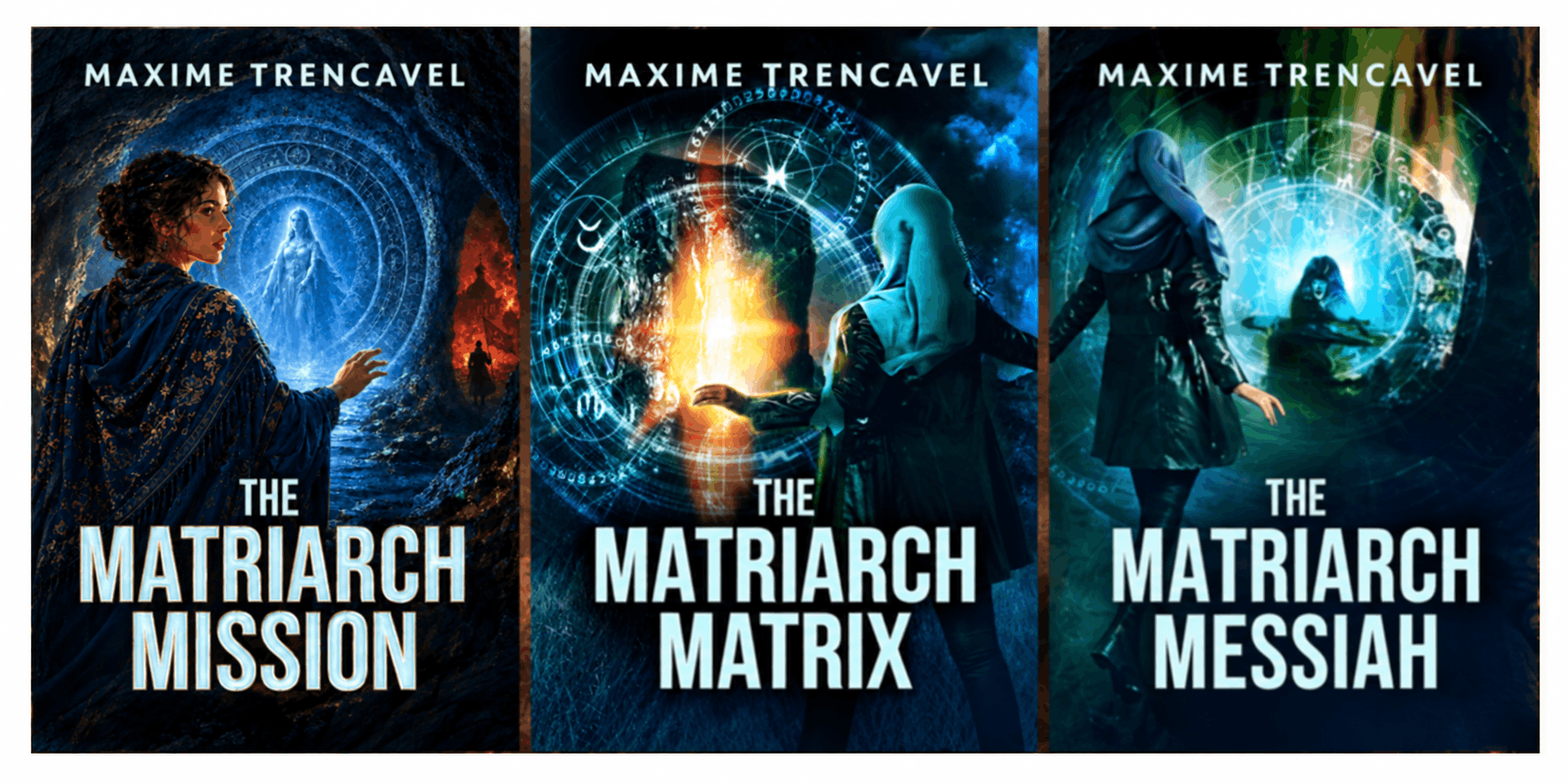
Some readers encounter that proposition, and the doors of their minds close. Too feminist. Too revisionist. Too speculative. They have categorized the idea before they have lived inside it. They abandon the book at the point of discomfort — which is precisely the point where the book begins to do its truest work.

Others stay. Not because they agree, but because they are willing to hold an unfamiliar idea without crushing it. They let the story breathe. And somewhere around the third or fourth chapter, they notice something unsettling: the book has been quietly rearranging their assumptions without asking permission.

This is deliberate. I do not write polemics. I do not argue a thesis. I enact it—the reader lives it.

In The Matriarch Matrix, readers meet Alexander Murometz — a Russian oligarch who is crude, manipulative, threatening, and obsessed with power. Every reader forms the same instant judgment: villain. The brain categorizes him and moves on. But the story does not move on. It keeps returning to Alexander, showing moments of unexpected tenderness, flashes of genuine sacrifice, layers of pain beneath the bluster. By the end, the reader who stayed discovers that the man they dismissed in chapter three is one of the most complex figures in the narrative — and that their rush to judgment mirrored exactly the kind of prejudice the book is examining.

In The Matriarch Messiah, the mechanism goes deeper. Zara Khatum is a Kurdish Muslim woman. Peter Gollinger is a quiet American editor. Rachel Capsali is an Israeli Torah historian. Every reader arrives with assumptions about what these identities mean, what these people want, who is right and who is wrong. The story places them in conflict — and then, methodically, dissolves the categories the reader imposed. The Muslim woman is not who you assumed. The Israeli woman is not who you assumed. The quiet American is not who you assumed. The menacing Russian oligarch is not who you assumed. And the reader, if they are honest, must confront the fact that their assumptions came not from the text but from themselves.

This is uncomfortable. It is meant to be.

The readers who leave early — and some do — tend to leave at the moment of maximum discomfort. They leave when a character they liked does something they cannot forgive. They leave when the narrative refuses to confirm the judgment they already made. They leave when the story asks them to hold two contradictory ideas simultaneously and does not tell them which one is correct.

I understand this. We all prefer the story that confirms what we already believe. The story that sorts characters into heroes and villains by page ten and never revisits those assignments. The story where the Muslim woman is either a victim or a terrorist, never both, never neither. The story where the Russian oligarch is evil, full stop, end of discussion.

But that is not the world. And it is not my fiction. For tolerance, for peace will come when we have the courage to look into the beyond – what’s beyond our initial reactions and safety mechanisms.

The richness of any story — of any life — lives in the space between the first impression and the final understanding. The reader who abandons a book because a character confused them has chosen comfort over growth. The reader who stays, who tolerates the confusion, who lets the narrative challenge their pre-defined categories — that reader discovers something no summary or review can convey. They discover that the prejudice being examined in the story was operating inside them all along.

In The Matriarch Mission, the forthcoming prequel to the series, this mechanism operates at its most intimate. Oksana Mangupli narrates her own life in first person, present tense. The reader lives inside her consciousness for twenty-one chapters. They feel what she feels. They judge who she judges. They love who she loves.

And then the story asks them to reconsider every judgment they shared with her.

The husband she despised? The lover she adored? The monster who terrified her? The grand duchess she revered? Every character the reader categorized in the first half of the book is revealed, in the second half, to be more than the label they were assigned.

This is not a twist. It is not a trick. It is the lived experience of what happens when you refuse to let your first impression be your last.

Tolerance is not a political position. It is a cognitive discipline. It is the willingness to say: “I do not yet know enough to form a conclusion.” It is the willingness to sit with discomfort, to hold the door open a moment longer, to let the unfamiliar become familiar before you decide what it means.

The readers who find the deepest rewards in these books are not the ones who agree with every proposition. They are the ones who stayed when they were uncomfortable. They tolerated the ambiguity. They let the story finish its sentence before they interrupted.

And when they reached the end — when the final answer arrived, when “That is love” landed in their chest rather than their head — they understood something that no amount of argument could have taught them. They understood it because they felt it. Because the story did not tell them what to think. It showed them what they had been thinking all along and asked if that was truly enough.


Why the Mongols Never Conquered Jerusalem & Who Was El Qutlugh Khatun’s Nephew–Ghazan Khan

The Matriarch Messiah chapters with El Qutlugh and Asefeh were based on the limited historical records of the Mongols invasion of Syria. Ghazan Khan’s forces reached to 45 miles of Jerusalem with one historical record indicated a raiding party may have made it to Jerusalem. Hence, is crafted the story of El and Asefeh. The lore of the Golden Gate being removed by Ghazan is fictional, but his great grandfather Hulagu Khan did remove those gates.

The Mongols, during their westward expansions in the 13th and 14th centuries, came very close to Jerusalem—but historical evidence suggests they never actually occupied or controlled the city. However, their presence in the region had major consequences.

  1. The Mongols Under Hulagu Khan (1260) – The First Near Miss

In 1260, after destroying Baghdad (1258), Hulagu Khan led the Mongols into Syria, capturing:

  • Aleppo (January 1260)
  • Damascus (March 1260)

Mongol scouts reportedly raided near Jerusalem, but they did not enter the city. Why?

  • The Battle of Ain Jalut (September 1260) – The Mamluks of Egypt crushed the Mongols, forcing their retreat.
  • Hulagu’s Withdrawal – News of the Great Khan’s death pulled Hulagu back east, leaving only a small force in Syria.

Verdict: No evidence suggests Mongol troops entered Jerusalem itself.

During this time period, the Mongols removed and took the “Golden Gate” (also known as the “Gate of Mercy” or “Sha’ar Harachamim”) from Jerusalem to Damascus during their invasion in 1260 CE.

Why Did They Do This?

  • Symbolic Conquest – The Golden Gate held deep religious and strategic significance. It was believed by some Jewish traditions to be the gate through which the Messiah would enter Jerusalem. By dismantling it, the Mongols (or their allies) may have sought to assert dominance over the city and undermine its spiritual importance.
  • Military Strategy – The Mongols, led by Kitbuqa (a Nestorian Christian general under Hulagu Khan), were fighting the Mamluks for control of the Levant. Removing the gate could have been a tactic to weaken Jerusalem’s defenses or to transport valuable materials (like metals) for reuse elsewhere.
  • Retaliation or Superstition – Some accounts suggest the Mongols (or the Khwarezmian allies who sacked Jerusalem earlier in 1244) feared prophecies linked to the gate, leading them to dismantle it to prevent any divine intervention favoring their enemies.

The Mongols were soon defeated by the Mamluks at the Battle of Ain Jalut (1260), ending their advance into the region. The Golden Gate was later sealed by the Ottoman Sultan Suleiman the Magnificent in the 16th century, and it remains closed to this day due to both historical and religious reasons.

  1. Ghazan Khan’s Invasion (1299–1300) – The Closest Approach

Decades later, Ghazan Khan (a Muslim convert) invaded Syria and defeated the Mamluks at Wadi al-Khazandar (1299). His forces:

  • Took Damascus (January 1300)
  • Reached Gaza, just 45 miles from Jerusalem

Did they enter Jerusalem?

  • Some sources (like the Armenian historian Hayton of Corycus) claim Mongol patrols raided near the city, but no contemporary Arab or Persian chronicles confirm they entered.
  • Ghazan lacked the manpower to hold Syria long-term and withdrew by spring 1300.

Verdict: Possible skirmishes nearby, but no occupation.

  1. Later Attempts (1301, 1303) – Failed Follow-Ups

Ghazan launched two more invasions:

  • 1301 – Failed due to bad weather.
  • 1303 – Crushed by the Mamluks at Marj al-Suffar, ending Mongol hopes in Syria.

After this, the Ilkhanate never seriously threatened Jerusalem again.

Why Didn’t the Mongols Take Jerusalem?

  1. Logistics – Holding Syria required a permanent army; the Mongols were stretched thin.
  2. Mamluk Resistance – The Egyptians were a formidable enemy.
  3. No Religious Priority – Unlike the Crusaders, the Mongols saw Jerusalem as a strategic, not sacred, target.

Ghazan Khan: The Reformer Who Revived the Ilkhanate

The Ilkhanate, the Mongol state ruling Persia and the Middle East, reached its peak under Mahmud Ghazan Khan (r. 1295–1304). Unlike his predecessors, Ghazan was not just a conqueror—he was an administrator, reformer, and visionary who sought to stabilize and expand his realm through military strength, economic restructuring, and cultural patronage. His reign marked a turning point for the Ilkhanate, blending Mongol traditions with Persian governance and Islamic influence.

This blog post explores Ghazan Khan’s rise to power, his military campaigns, domestic reforms, and the lasting impact of his rule on the Mongol Empire and the broader Islamic world.

  1. Ghazan’s Rise to Power

Ghazan was born in 1271, the son of Arghun Khan and a Christian mother. Raised as a Buddhist, he later converted to Islam in 1295, a decision that reshaped the Ilkhanate’s identity. His conversion was both political and personal—it helped him secure the loyalty of Persia’s Muslim majority while distancing himself from his predecessors’ failed policies.

Overthrowing Gaykhatu

Before becoming Ilkhan, Ghazan served as governor of Khorasan. When his cousin Gaykhatu (r. 1291–1295) proved incompetent—famously bankrupting the treasury with a failed paper currency experiment—Ghazan led a revolt. In 1295, he defeated Gaykhatu’s successor, Baydu, and seized the throne.

  1. Military Campaigns: Expansion and Defense

Ghazan inherited an Ilkhanate weakened by financial crisis, Mamluk threats, and internal rebellions. His military strategy focused on:

War Against the Mamluks

The Mamluks of Egypt had long been the Ilkhanate’s greatest enemy. Ghazan launched multiple invasions of Syria:

  • 1299–1300 Campaign: Ghazan crushed the Mamluks at the Battle of Wadi al-Khazandar, briefly capturing Damascus. However, supply shortages forced a retreat.
  • 1301 & 1303 Invasions: Both failed due to logistical issues and fierce Mamluk resistance.

Despite not securing permanent gains, Ghazan kept the Mamluks on the defensive, proving the Ilkhanate was still a formidable power.

Suppressing Revolts

Ghazan faced rebellions from:

  • Nawruz, a former ally who turned against him.
  • Disloyal Mongol factions resisting his Islamic policies.

Through decisive action, Ghazan crushed these uprisings, consolidating his rule.

  1. 3. Ghazan’s Revolutionary Reforms

Ghazan’s greatest legacy was not conquest but governance. He implemented sweeping reforms to stabilize the economy and administration:

  1. Land & Tax Reforms
  • Ended arbitrary taxation by introducing fixed rates.
  • Redistributed land to peasants to boost agriculture.
  • Punished corrupt officials, restoring trust in the government.
  1. Monetary & Trade Policies
  • Standardized coinage to combat inflation.
  • Encouraged Silk Road trade, revitalizing commerce.
  1. Legal & Religious Policies
  • Upheld Sharia law while respecting Mongol traditions.
  • Patronized scholars, artists, and historians, including Rashid al-Din, his vizier and chronicler.

These reforms revived the Ilkhanate’s economy and strengthened its administration, setting a model for future Islamic empires.

  1. Cultural & Scientific Patronage

Ghazan was a renaissance ruler who fostered intellectual growth:

  • Built mosques, schools, and observatories.
  • Commissioned the Jami al-Tawarikh (Compendium of Chronicles), one of history’s first world histories.
  • Encouraged Persian as the court language, blending Mongol and Persian culture.

His reign marked the beginning of a Persian-Mongol synthesis that influenced later dynasties like the Timurids and Safavids.

Why Ghazan Matters

  1. Saved the Ilkhanate from collapse through reforms.
  2. Pioneered Islamic-Mongol fusion, shaping Persia’s future.
  3. His military campaigns kept the Mamluks in check, delaying their dominance.

Though the Ilkhanate fragmented after his death, Ghazan’s influence endured. His reign proved that even a nomadic conqueror could become an enlightened ruler—one who valued law, culture, and stability as much as war.

The Reality of Zara Khatum’s Fictional Devastating Enslavement

The fictionalized Kurdish character Zara has been lauded in reviews for the depth and complexity of her character. Her fictional external would, her rationalization for her behavior, her desire to die to save others, comes from a very non-fictional tragedy. The abduction, rape, and sale into slavery of 6,800 Yazidi women and children in the 2014 Sinjar Massacre.

Zara’s trauma, because of her fictional kidnapping by the Daesh as she visited her Yazidi cousins, and the vivid portrayal of similar massacres and mass violations of women in the fictional ancient times chapters, led some reviewers to criticize The Matriarch Matrix. The intent of this storyline was to highlight the injustices committed against women not only in 2014, but across humanity’s dark history.

In The Matriarch Messiah, Zara’s inner wound is finally exposed. The one she loves the most plays the most unconventional therapist helping her seek redemption, forgiveness, and acceptance. Her inner wound stems from not her own kidnapping, but the fate of her Yazidi cousins.

*****

To help readers better understand not only the history behind Zara’s fictional wound, but highlight the tragedy of that war, a summary lies below with references for more reading:

The 2014 Sinjar Massacre: A Tragedy of Sexual Violence and the Yazidi Struggle for Healing
In August 2014, the Islamic State (as my editor had commented, the term DAESH is a less religiously judgmental term) launched a brutal campaign against the Yazidi community in Sinjar, northern Iraq, marking one of the darkest chapters of modern genocide. The attack, aimed at eradicating the ethnoreligious minority, resulted in the massacre of thousands of men, the abduction of approximately 6,800 women and children, and the displacement of over 400,000 Yazidis. While the world has since recognized these atrocities as genocide, the survivors—particularly women and girls subjected to rape, sexual slavery, and torture—continue to grapple with profound trauma. Their journey toward healing remains fraught with systemic challenges, even as thousands remain missing nearly a decade later.

The Scale of Abductions and the Fight for Return
Of the estimated 6,800 Yazidis abducted by DAESH, roughly 3,000 were women and girls forced into sexual slavery. As of late 2023, approximately 2,800 survivors have been rescued or escaped, often through perilous efforts by activists, families, or international organizations. Tragically, around 2,700 remain unaccounted for. Many were trafficked across DAESH-held territories in Iraq and Syria, sold in markets, or given as “gifts” to fighters. While some have been located in refugee camps, detention centers, or households of former DAESH collaborators, recovery efforts are hindered by bureaucracy, lack of resources, and the scattered aftermath of DAESH’s territorial defeat.

Trauma and the Battle for Reintegration
Survivors who return face a labyrinth of psychological, physical, and social scars. Sexual violence was weaponized systematically: girls as young as nine were subjected to repeated rape, forced marriage, and pregnancy. Many endure chronic pain from injuries or sexually transmitted infections, while others bear children conceived through rape—a reality that complicates their acceptance in a conservative community grappling with stigma.

The Yazidi women who survived captivity and returned home faced profound physical and psychological trauma. Physically, many suffered from chronic pain, injuries, and health complications resulting from abuse and neglect during their captivity. Psychologically, survivors experienced severe conditions such as post-traumatic stress disorder (PTSD), depression, anxiety, and dissociation. Nightmares, flashbacks, and feelings of guilt were common, alongside struggles with social rejection and reintegration into their communities.

Psychologically, survivors report severe post-traumatic stress disorder (PTSD), depression, and suicidal ideation. A 2021 study by the Journal of Traumatic Stress found that 97% of Yazidi women survivors exhibited PTSD symptoms, and 68% had attempted suicide. Social reintegration is equally fraught. Some families, influenced by patriarchal norms, reject survivors due to misplaced shame, while others struggle to support them amid poverty and displacement. Organizations like Nadia’s Initiative, founded by Nobel laureate Nadia Murad (herself a survivor), provide trauma counseling, economic programs, and advocacy, yet funding and accessibility remain inconsistent.

Historical Parallels: Sexual Violence as a Weapon of War
The Sinjar Massacre is not an isolated horror. Over the past two centuries, mass sexual violence has repeatedly been deployed to terrorize populations:

Nanjing Massacre (1937–1938): During Japan’s occupation of Nanjing, soldiers raped 20,000–80,000 Chinese women, often murdering them afterward. Survivors faced lifelong stigma, with many remaining silent until their deaths.

  • Bangladesh Liberation War (1971): Pakistani forces raped 200,000–400,000 Bengali women, whom the government later labeled “war heroines” to mitigate ostracization—a controversial gesture that failed to address their trauma.
  • Rwandan Genocide (1994): An estimated 250,000–500,000 Tutsi women were raped by Hutu militias, with HIV used as a deliberate tool of genocide. Many died of AIDS, leaving orphaned children.
  • Bosnian War (1992–1995): Serb forces established “rape camps,” targeting 20,000–50,000 Bosniak women. Children born from these assaults, like those of Yazidi survivors, often face identity crises.
  • Comfort Women System (1932–1945): Imperial Japan enslaved 200,000 women across Asia in military brothels, a crime denied by Japanese authorities for decades.

These examples reveal a grim pattern: sexual violence as a tool of ethnic cleansing, demoralization, and patriarchal domination.

References:
Yazidi Women Surviving Daesh: Between Psychological Traumas and the Struggle to Reintegrate to Society – Women Across Frontiers Magazine

Survival after Sexual Violence and Genocide: Trauma and Healing for Yazidi Women in Northern Iraq

Trauma and perceived social rejection among Yazidi women and girls who survived enslavement and genocide | BMC Medicine | Full Text


Formidable! Super awesome Five Star Review from Self-Publishing Review

Much to my utter delight, SPR released their review of The Matriarch Messiah today.

https://www.selfpublishingreview.com/2025/03/review-the-matriarch-messiah-by-maxine-trencavel/

I fell in love with the review, how well it was crafted, how well the reviewer consider not only the content of the book, but the craft of the prose.

Within the wildly original fantasy/sci-fi premise and historical/political issues, there is a poignant timeliness to the prose; Trencavel’s writing is both clear and eccentric, making the reading experience an engaging pleasure for logophiles and lay readers alike. Unexpected vocabulary choices, visceral turns of phrase, and the ability to summon stark and compelling landscapes in readers’ minds give the prose an electric and almost sacred quality, unburdened by frivolous detail or narrative filler.

The beating heart of this book and the thematic basis of the entire series is that a return to female empowerment and a divestment from hate-filled legacies are crucial for our collective survival. Unapologetically highlighting the true power of women as the bringers and protectors of life, and elevating them to bearers of a divine message, Trencavel delivers a stunning blow to patriarchal norms across a broad array of cultures and literary traditions.

My deepest thanks and appreciation for the love and care this reviewer took to summarize their findings and understanding of this author set out to inspire and create. Merci!

First Manuscript Draft Finished – The Matriarch Mission: Prequel

Where did Rachel Capsali, in The Matriarch Messiah, find her all consuming passion to find the truth about Asherah?

Where did Alexander Murometz get the funding to create his all powerful MoxWorld Empire so he could solve the mystery of the ancients and find the legendary black object?

Who said Zara Khatun will end the world as we know it [plot spoiler] in the final book of the series, The Matriarch Mandate?

All will be reveal in the Mystery of the Matriarchs’ prequel: The Matriarch Mission.

Last December I resurrected the prequel’s research, outline, along with the two chapters crafted before the pandemic. In the winter warmth of Madrid and Barcelona, the first new chapters in nearly five years came flying off the keyboard. Three months later, in the midst of launching The Matriarch Messiah, the first full manuscript of the Mystery of the Matriarchs prequel is finished ready for final alpha reader feedback, self-editing, then off to beta readers. Expect publication end of the summer of 2025 assuming the editors I choose can keep to a committed timeline (a chronic problem with the last two books).

With the advent of generative AI and advance machine language, here are glimpses of this story which pre-dates the events of The Matriarch Matrix by eighty years:

PROWRITINGAID:

Genre: Fantasy (Historical Fantasy with Mystical Realism elements}

Oksana Mangupli, a Krymchak girl with an insatiable thirst for knowledge, finds her life intertwined with ancient legends, mystical powers, and the tumultuous backdrop of revolutionary Russia. Caught between family expectations, forbidden love, and a hidden destiny, Oksana must navigate dangerous political landscapes and confront terrifying truths about her heritage to  protect her family  and fulfill her unique role in a world-altering quest.

Plot Outline

  1. The Cavern: Oksana’s dying grandmother leads her to a hidden cavern, where she encounters a mysterious woman named Asherah, who speaks of a destiny tied to a “blue light.”
  2. The Romanovs: Oksana meets Grand Duke Nicholas Nikolaevich and his wife, Anastasia, who believe she holds the key to restoring Russia and uncovering a mystical black object. Anastasia introduces her to an attractive soldier assigned to train her – Mirko. A love story for the ages ensues.
  3. Zoran Murometz: Oksana is tasked with assisting the enigmatic Zoran Murometz in researching ancient texts, uncovering a connection to the “tail of the bird star” and a genetic anomaly shared by certain individuals.
  4. The Kola Expedition: Oksana joins an expedition to the Kola Peninsula, where they encounter giants and search for an Agartthan portal, facing dangers and uncovering clues about her connection to ancient legends. There she meets with Asherah’s mother, Thula, who reveals Oksana’s descendants’ destiny.
  5. The Choice: Oksana faces a difficult decision as she must choose a path that will protect her daughter and determine the fate of those involved in the search for the black object and the cavern of the blue light. What is true love? Who does she choose?

AUTOCRIT: 

Overall Premise: The story follows Oksana—a young Krymchak woman caught in the turbulent early‑twentieth‑century Russia—as she embarks on a mystically charged quest intertwined with ancient prophecies, political upheaval, and deeply personal family dramas. Guided by mysterious figures like Asherah and manipulated by powerful forces in the crumbling world of the Romanovs and later Bolshevik turmoil, Oksana must reconcile her duty to her family and cultural traditions with her own desire for knowledge, self‑determination, and love. The narrative weaves historical events with occult mysteries and personal redemption, setting an ambitious stage where destiny collides with modern hardship.


1. Market Overview

  • Genre & Themes:
    This narrative fits squarely into the cross-genre territory of historical fantasy and speculative fiction with strong elements of myth, magical realism, and political drama. Its blend of real historical events (including the Bolshevik Revolution and World War II) with mystical artifacts, ancient prophecies, and supernatural lore appeals to readers who appreciate complex, layered storytelling.
  • Narrative Complexity:
    The story spans multiple chapters and time periods, featuring non-linear timelines, multiple character perspectives, and a rich tapestry of subplots. The text’s ambitious scope may attract a readership that favors epic, immersive narratives akin to those found in classic historical epics or modern fantasy sagas.
  • Comparative Titles:
    Works such as “Jonathan Strange & Mr Norrell” by Susanna Clarke, “The Baroque Cycle” by Neal Stephenson, and even elements of “The Historian” by Elizabeth Kostova share thematic similarities. This places the work within a competitive market niche that merges historical settings with fantastical elements.

Why The Pre-Neolithic Sub-Plot? A Waste of Words? Or A Deeper Meaning?

Sci-Fi fans might remember the epic quote from Battlestar Galactica’s Cylon Number Six “All of this has happened before. All of this will happen again.”, suggesting a cyclical nature to history and the potential for repeating past mistakes.

In the same fashion, both The Matriarch Matrix and The Matriarch Messiah feature past lives sub-plots adding 30K or so extra words creating the epic nature of these works. The “ancients”, the pre-Neolithic family and descendants of the great matriarch, Nanshe, tell a parallel ancestorial history from which the future of modern day Peter and Zara can be guided by through their “bondings”.

The “ancients” storyline also serves to show how traditions from 12,000 years ago could have been passed from generation to generation and formed many of the idiosyncratic elements of cultures and faiths which might mystify or confuse outside onlookers. The morale of these stories is we must seek to understand others different from us, their history, their cultures, before we pass judgement. For the lack of doing so leads to violence, wars, and in dystopic science fiction, the end of our world.

What is so special about Talla and Nirra’s Çatalhöyük village?

Nestled in the Anatolian plains of Turkey, the ancient settlement of Çatalhöyük stands as a testament to the ingenuity and complexity of early human societies. Dating back to 9,500 BCE, this remarkably well-preserved Neolithic city offers a glimpse into a time when agriculture and communal living were taking root, forever shaping the trajectory of human civilization. But beyond its architectural marvels, Çatalhöyük offers a fascinating narrative about gender roles and societal structures, challenging our modern perceptions of early human history.

The excavated remains of Çatalhöyük reveal a unique and intricate city layout. Houses, built close together with no discernible streets, were accessed through openings in the roof, creating a labyrinthine network of interconnected dwellings. The interior spaces contained evidence of communal living, with hearths for cooking, sleeping platforms, and storage areas. While this architectural style may seem unusual to modern eyes, it speaks volumes about the social organization of this ancient community.

What truly sets Çatalhöyük apart is the evidence of gender equality unearthed within its walls. The skeletal remains of both men and women, discovered in similar positions and with comparable access to resources, challenge the long-held assumption that ancient societies were dominated by men. This equality is further reinforced by the artifacts and tools discovered in the houses, which show that both genders took part in hunting, farming, and crafting.

The presence of elaborate burial rituals and the discovery of figurines representing both male and female figures with equal prominence suggest a society that revered both genders and recognized their importance. The lack of a clear hierarchy or distinction in burial rites suggests a level of equality that was not just social but also spiritual, reflecting a communal understanding of shared values and respect.

Çatalhöyük also offers clues about the artistic and symbolic world of these Early Neolithic people. Wall paintings depict scenes of hunting, animal life, and abstract motifs, hinting at a rich and vibrant cultural life. The discovery of numerous figurines representing deities and mythical figures further reinforces the presence of a complex belief system.

However, it is the lack of evidence for warfare that truly surprises modern researchers. Unlike other Neolithic settlements with clear signs of conflict and violence, Çatalhöyük reveals a peaceful, communal society, prioritizing collaboration and cooperation. This peaceful coexistence is reflected in the harmonious, interconnected nature of the houses, the absence of defensive structures, and the relative lack of weapons.

Çatalhöyük’s significance lies not only in its historical value but also in its powerful implications for our modern culture. The discovery of a gender-egalitarian society at the dawn of civilization challenges our understanding of ancient societal structures. It challenges the assumption that hierarchy and male dominance were inherent to early human communities. Instead, it provides evidence of a society where women were not simply relegated to domestic roles but were active and respected members of the community.

This discovery also prompts us to reexamine our understanding of human development. The peaceful nature of Çatalhöyük challenges the conventional narrative of the Neolithic period as a time of constant warfare and violent struggle. It shows that humans were capable of forming complex societies based on cooperation, shared values, and mutual respect.

Who are Tallia and Nirra? And what is their connection to Çatalhöyük?

The fictional journey of Tallia and Nirra in “The Matriarch Messiah” provides an interesting lens through which to explore these concepts. Their lives in Çatalhöyük, highlight the transformative power of choice and the possibility of finding a better way even when faced with a brutal, oppressive past.

This concept of equality is well exemplified in the fictional account of Tallia and Nirra, two characters from the novel “The Matriarch Messiah” who created Çatalhöyük based on the shared belief in equality in their marriage of disparate unequals. Tallia, a descendant of the ancient matriarch Nanshe, and Nirra, a reformed reindeer warrior giant, challenge the conventional assumptions about their respective roles in a Neolithic society.

While Tallia carries the legacy of her matriarchal lineage, Nirra, born into a culture of violence and dominance, seeks redemption and a new life based on peace and equality. He finds solace in the village, learning to respect and honor the values of a society where men and women work side-by-side, share responsibilities, and live as equals.

This is reflected in their shared home—a square hut built in contrast to the traditional circular huts of Tallia’s ancestors, signifying a conscious effort to break away from the past and embrace a new reality of inclusivity. Their lives in this village offer a microcosm of the larger societal values of Çatalhöyük, highlighting the possibilities of change and the potential for peaceful coexistence.

Readers of “The Matriarch Messiah” are invited to reimagine the Neolithic period through the lens of Çatalhöyük. They can question traditional narratives of ancient societies and explore the possibilities of peaceful coexistence and gender equality in the early stages of human civilization. They can find inspiration in the story of the matriarchal lineage, challenging the patriarchal structures of many modern societies and envisioning a future where women are empowered and respected.

Çatalhöyük serves as a reminder that history is not always black and white. It is a tapestry woven with diverse threads, offering multiple perspectives and challenging our preconceived notions about our past and our future. By embracing the lessons of Çatalhöyük, we can move forward with a greater understanding of our shared humanity and the potential for a more harmonious and equitable future.

OMG! Three 5 Star Reader Favorite Reviews

First reader reviews ever for The Matriarch Messiah.


Find them here:https://tailofthebird.com/readers-favorite-reviews-march-2025


Excerpts:

“The love triangle between Zara, Rachel, and Peter creates emotional stakes and was something I didn’t expect to enjoy as much as I did. I loved their love triangle, but, more than that, I loved the rich world-building and the amazing development of the three main characters. I enjoyed how Rachel and Zara are two very different yet very similar women. I loved the twists and turns, how the fast pace kept me entertained, and how the story ended.”

“I was struck by how thrilling the adventure was, but especially how thought-provoking the themes of power were in the relationships the characters have with forces way beyond their control. There’s also a lot to relate to in Zara’s emotional journey and readers will root for her thanks to the way they have access to her innermost thoughts.”

“The dialogue transitions from deeply emotional romantic exchanges to entertainingly informative mentions of the mating and suppression habits of a race of violent giants, enhancing the suspense. Maxime Trencavel’s storytelling style shines through as the author crafts each character’s motives cohesively.”


The Matriarch Messiah – Pre Sale Starts March 3, 2025

The final manuscript is finally proofed and ready to go to formatters.

Here’s what Autocrit says about the manuscript:

Overall Genre Identification: The text is best described as speculative historical thriller with strong elements of mystery, supernatural fantasy, and speculative science fiction. It combines the atmospheric tension of geopolitical thrillers, the mythic resonance of historical epics, and futuristic intrigue driven by advanced technology and genetic experiments.

Overall Premise: The story is an epic, multi-layered narrative blending historical mystery, supernatural intrigue, futuristic technology, and ancient prophecies. At its core, the novel follows a sprawling cast—from World War‑era paranormal research teams and ancient matriarchs in prehistoric Anatolia to modern-day negotiators and corporate magnates—as they unravel bizarre relics (such as the “black stone” and the “blue light”) and contend with past traumas, secret genetic legacies, and messianic destinies. Personal relationships, political intrigue, and esoteric conventions intertwine as characters battle inner demons and global threats, making the narrative as much a journey of self‐redemption as it is a quest to save—and understand—the world.

Target Genre:

The overall genre of the book is speculative fiction, which encompasses elements that explore imaginative and futuristic concepts.

Sub-genres include:

  1. Historical Fiction
    • The narrative weaves historical events, such as those during World War II and ancient civilizations.
  2. Fantasy
    • Elements of magic, supernatural beings, and prophecies are present throughout the story.
  3. Thriller/Suspense
    • There are intense moments involving conflict, danger, and high-stakes situations among characters.
  4. Science Fiction
    • Technological advancements like MoxWorld devices and genetic experimentation play a significant role in the plot.

These genres combine to create a rich tapestry of storytelling that explores complex themes through various character perspectives across different timelines and settings.

Similar but different, Google Gemini says this about the book’s genre:

The primary genre of this book is science fiction.

The secondary genres are:

  • Fantasy: The story involves a magical object, supernatural powers, and a prophecy.
  • Romance: The story focuses on the romantic relationships between Zara and Peter, Mei and Peter, and Tallia and Nirra.
  • Adventure: The characters embark on a quest to find a mythical object and save the world.
  • Thriller: The story features suspenseful plot twists and dangerous situations.

Target Tropes

  1. The Chosen One: This trope features a character, often with special abilities or a significant destiny, who is selected to fulfill a crucial role in saving the world or resolving major conflicts. In the text, Zara embodies this as she grapples with her identity and responsibilities tied to ancient prophecies.
  2. Family Legacy: Characters are often driven by their family history and expectations, influencing their actions and decisions throughout the narrative. Nikolas Gollinger’s journey reflects this as he contends with his family’s paranormal research legacy.
  3. Betrayal of Trust: Relationships are tested when characters betray one another for personal gain or survival. Multiple instances occur throughout the story where trust is broken among allies, leading to dramatic confrontations.
  4. Sacrifice for Love: A common theme where characters must make difficult choices that involve sacrificing their own desires or lives for loved ones’ well-being or greater causes. Tallia’s willingness to sacrifice herself illustrates this trope vividly.
  5. Mystical Prophecy: The presence of prophecies that guide characters’ paths and foreshadow events plays a significant role in shaping actions within the story. Various characters receive cryptic messages about their destinies related to ancient artifacts and powers.

The Matriarch Matrix: Anchored in Pre-Neolithic Archeology Findings

The ancients’ story plays a pivotal role in The Matriarch Matrix. The journey of Orzu and Nanshe from the Crimea to Anatolia is a reader favorite. Their story is founded on actual archeologic findings. Nanshe, the great matriarch of the story, founded the temple at Göbekli Tepe. Their family founds settlements at other similar developments.

Archeology since the publication of The Matriarch Matrix has continued to validate the extent of technology and art of the actual people who lived in the fictional times of the great matriarch Nanshe.

One such site is Karahan Tepe, lying 46 kilometers east of Göbekli Tepe.

Historical Significance

Karahan Tepe holds immense historical significance as it challenges traditional views on the development of early human societies. The site includes homes within a vast ritualistic complex, indicating that the inhabitants built permanent settlements long before the advent of agriculture.

This suggests that settled life began while humans were still hunter-gatherers, and agriculture was a result, not a cause, of settled life. The presence of both sacred and secular spaces at Karahan Tepe highlights the complexity of these early societies and their ability to engage in ritualistic practices alongside daily activities.

Discoveries Since 2018

Since 2018, Karahan Tepe has continued to reveal its secrets, providing a deeper understanding of early human civilization. Excavations have uncovered numerous monumental statues, architectural elements, and painted sculptures from the pre-Pottery Neolithic era (PPNA and PPNB), dating back to the 10th to 9th millennia BCE.

Among the most notable discoveries are a 2.3-meter tall statue of a seated figure holding a phallus, considered one of the earliest examples of realistic human sculpture. Additionally, a vulture statue with detailed features was found, showcasing the high level of craftsmanship of the site’s inhabitants.

Astronomical Implications and Ancient Aliens Theories

Karahan Tepe’s monumental structures and intricate carvings suggest advanced astronomical knowledge. One of the most intriguing discoveries is the site’s alignment with the winter solstice, indicating that its builders had a sophisticated understanding of celestial events.

This alignment, along with the site’s acoustical properties and shamanic symbolism, has led some researchers to propose that Karahan Tepe was used by shamans to connect with the Milky Way’s Galactic bulge, seen as the head of the cosmic serpent.

Theories about ancient aliens have also emerged, with some suggesting that the advanced engineering and astronomical knowledge displayed at Karahan Tepe could be evidence of extraterrestrial influence.

These theories often draw parallels between Karahan Tepe and other ancient sites around the world, proposing that a lost supercivilization or extraterrestrial beings may have played a role in the development of early human societies.

Relation to Göbekli Tepe

Karahan Tepe is often compared to its more famous neighbor, Göbekli Tepe, located about 40 kilometers away. Both sites share similar architectural features, including T-shaped pillars and animal sculptures, suggesting a cultural connection between the two. Karahan Tepe is part of a broader region known as Taş Tepeler, which includes several other prehistoric sites that collectively provide a more comprehensive understanding of early human civilization in the region.

While Göbekli Tepe is often referred to as the “zero-point of history,” Karahan Tepe’s discoveries indicate that it may be even older, potentially predating Göbekli Tepe. The similarities between the two sites suggest that they were part of a network of interconnected settlements that played a crucial role in the development of early human societies.

Inhabitants of Karahan Tepe

The people who lived at Karahan Tepe were part of a complex hunter-gatherer society that built permanent settlements and engaged in ritualistic practices. Despite the presence of permanent structures, there is no evidence of farmed vegetation, indicating that the inhabitants relied on hunting and gathering for sustenance. The site’s elaborate architecture and artistic achievements reflect a high level of social organization and cultural development.

Excavations at Karahan Tepe have revealed multiple layers of residential structures. The site includes various domestic buildings, communal structures, and enclosures, indicating a long-term, complex settlement. These layers provide valuable insights into the architectural and social evolution of the people who lived there over time.

The inhabitants of Karahan Tepe were skilled craftsmen, as evidenced by the detailed sculptures and carvings found at the site. Their ability to create realistic human figures and intricate animal depictions suggests a deep understanding of both artistic techniques and symbolic representation. The presence of both sacred and secular spaces indicates that the people of Karahan Tepe had a rich spiritual life, with rituals and ceremonies playing a central role in their society.

Conclusion

Karahan Tepe continues to captivate archaeologists and historians with its rich array of discoveries and its potential to reshape our understanding of early human civilization. The site’s monumental architecture, advanced astronomical knowledge, and intricate carvings provide valuable insights into the lives and beliefs of its inhabitants. As excavations continue, Karahan Tepe promises to reveal even more about the complex societies that existed long before the advent of agriculture, challenging our preconceptions about the origins of settled life and the development of early human cultures.

Jiang Yuan: The Revered Matriarch Goddess of Ancient China

In the annals of Chinese mythology, few figures are as intriguing and venerated as Jiang Yuan, a goddess whose history intertwines the celestial with the earthly. Hailing from a mystical origin in the West, Jiang Yuan is celebrated not just as a divine being but as the progenitor of some of China’s earliest emperors. Her story, rich in symbolism and divine intervention, offers a fascinating glimpse into the spiritual and cultural fabric of ancient China.
She is featured as the patron goddess of Mei Tang in the novel The Matriarch Messiah showcasing the diversity of beliefs, culture, and faith across the world.
Origins from the West


According to legend, Jiang Yuan originated from the West—a detail often interpreted as symbolic, possibly representing a divine but unknown place or a confluence of different cultural influences that she embodied. Her miraculous arrival set the stage for a tale that would leave a profound imprint on Chinese mythology.
She is estimated to have lived during the time of the legendary Five Emperors, which is a period based on myth and legend. Some say this era was around 2000-2500 BCE – the age of Sumerians and Akkadians as well as the Old Kingdom of Egypt.

The Immaculate Impregnation

Jiang Yuan’s most celebrated myth involves the immaculate conception that led to the birth of Hou Ji, a culture hero and deity associated with agriculture, who was key to the survival and prosperity of China’s early societies. The story goes that Jiang Yuan, a chaste woman disturbed by the thought of marrying, took a walk in the wilderness to reflect upon her life. During her journey, she stepped inadvertently into a giant footprint. This was no ordinary footprint; it was miraculous and believed to belong to a great giant associated with the divine realm.
This simple act led to Jiang Yuan’s miraculous impregnation. Overwhelmed by the supernatural nature of her conception, she bore a son named Hou Ji, whose name signifies the “Lord of Millet.” Hou Ji would later be venerated as a god of agriculture, responsible for introducing millet cultivation to humanity, drastically altering the course of agriculture and aiding the stabilization and growth of civilizations.
Relationship with Emperor Ku (Di Ku)

While traditional sources predominantly stress Jiang Yuan’s matronly role, her presence in mythology is further amplified by her relationship with Emperor Ku (also known as Di Ku), one of the ancient sage-kings of China. Known as the first consort to Emperor Ku, their union of powerful entities is a divine endorsement of the lineage that would perpetuate through the ages, reinforcing the divine right of kingship and the celestial approval of the ruling families.
Influence on China

Jiang Yuan’s influence on Chinese culture and religion extends beyond her mythological narratives. As the mother of Hou Ji, she is indirectly responsible for one of China’s central agricultural advancements. This act alone situates her as a key figure in the survival and success of early Chinese civilizations, linking her to the seasonal cycles and harvests, essential aspects of agrarian society.

Moreover, Jiang Yuan is revered for her virtues of chastity and piety, embodying the ideal feminine virtues extolled in various epochs of Chinese history. Her story is also a testament to the powerful role of women in ancient mythologies and royal genealogies, often serving as crucial links between the divine and the mortal realms.

Legacy

Today, Jiang Yuan stands as a testament to ancient Chinese spirituality and cultural values, reflecting an era where gods and mortals interacted closely, and where the divine directly influenced the everyday life of the people. Her legends offer more than mere tales of gods and heroes; they serve as foundational narratives that have shaped the cultural and spiritual landscape of China for millennia, reminding us of the deep and enduring connection between the land and its spiritual guardians.

El Qutlugh Khatun: A Mongol Princess Bridging Cultures Through Her Incredible Journey

In the annals of the Mongol Empire’s expansive history, tales of conquest and dominion often eclipse the remarkable personal stories of its figures, especially women. Not so for El Qutlugh Khatun, daughter of Abagha Ilkhan, the ruler of the Ilkhanate from 1265-82. Her life is a compelling narrative of martial prowess, religious devotion, and cultural integration, making her one of the most fascinating figures in the Ilkhanid era. Let’s delve into the life of this Mongol princess who not only broke gender norms but also contributed significantly to the Islamification of Mongol culture through her actions and travels.

Warrior Princess Defying Gender Norms

In a culture where warfare and bravery were predominantly male attributes, El Qutlugh Khatun stood out for her combat skills and courage. Historically, Mongol women had more freedom compared to their counterparts in other contemporary societies; they rode horses, practiced archery, and participated in the governance and military strategies that were crucial to the Mongol’s nomadic way of life.

El Qutlugh was a woman of great strength and courage. She embodied the legacy of Mongol women in the Eurasian Steppe, known for their independence and active participation in society. When her husband Ghurbati, a prominent Mongol commander, was murdered, El Qutlugh took matters into her own hands. She rode into battle, slew his killer, and carried his severed head on her horse for days, a stark reminder of her unwavering determination and powerful sense of justice. This act of revenge, while shocking in its brutality, was a testament to her ability to break free from traditional gender roles and challenge the patriarchal structures of her time.

El Qutlugh’s defiance didn’t stop there. When the Mamluk commander Aqqush al-Afram, known for his ambition and influence, proposed marriage, she rejected him outright. Her response was scathing, stating that he was not even worthy of being a horse groom for her. This rejection was not simply a refusal of a suitor; it was a powerful statement of her self-worth, demonstrating her disdain for the Mamluks’ position as slaves compared to her Chinggisid lineage.

A Devout Figure in the Islamification of Mongol Culture

El Qutlugh’s contributions were not limited to the battlefield. During a period when the Mongols were transitioning from traditional shamanistic beliefs to Islam, she played a pivotal role in the Islamification process within the Ilkhanate. Her devotion to Islam was profound, as evidenced by her pilgrimage to Mecca — an undertaking that was both a personal religious commitment and a politically significant act. It underscored the acceptance and integration of Islamic practices within the Mongol elite, serving as a bridge between Mongol traditions and the Islamic faith.

Her pilgrimage in 1323, which coincided with the period of newly established peace between the Ilkhanate and the Mamluk Sultanate, was not just a spiritual journey but also a diplomatic gesture that helped to solidify the peaceful relations between these two powerful states. Furthermore, her generous donations during the Hajj exemplified the Islamic virtue of charity, reinforcing her image as a pious Muslim.

Cultural Mediator Through Travels

El Qutlugh’s travels, especially her pilgrimage, also highlighted her role as a cultural mediator. The Mongol Empire was known for its vast connections and interactions among different cultures, and her journey from the Persian heartland of the Ilkhanate to the holy city of Mecca was a high-profile event that drew attention from all across the Islamic world. By undertaking the Hajj, she not only fulfilled an important Islamic duty but also brought the Mongol presence into the Islamic cultural sphere, helping to weave the Mongol identity into the broader tapestry of Islamic civilization.

Throughout her journey, she continued engaging in traditional Mongol practices such as hunting, displaying her skills in horsemanship and archery. These activities, while rooted in her cultural heritage, were performed in a landscape that was foreign to her traditions, showcasing the adaptability and openness of Mongol culture under Islamic influence.

Conclusion

El Qutlugh Khatun’s life is a spectacular narrative of a woman who maneuvered through the complexities of her time with grace and strength. Her story is a powerful testament to the resilience and defiance of the human spirit. She broke through the confines of tradition, challenged societal expectations, and lived a life that was both courageous and devout. Her journey, from her act of revenge to her pilgrimage to Mecca, serves as a beacon of individual strength, challenging us to reconsider the possibilities of life beyond pre-defined boundaries and embrace the dynamism of change.

Who is Asherah? Ancient Goddess and Her Controversial Connection to Yahweh

In the intricate tapestry of ancient Near Eastern religions, Asherah, a goddess worshiped in the ancient Levant, emerges as a figure of considerable intrigue and controversy. Recent archaeological findings and scholarly research have reignited debate over her role and her potential connections to Yahweh, the God of the biblical Israelites. This post delves into the captivating evidence and varying perspectives on whether Asherah might have been considered Yahweh’s consort, exploring the implications of this for our understanding of ancient religious practices.

Who is Asherah?

Asherah, often associated with fertility, motherhood, and the sea, was a prominent deity in the ancient Near Eastern pantheon. References to Asherah appear not only in the archaeological records of Canaan but also in texts from Ugarit, and through mentions in the Hebrew Bible. However, in these Biblical texts, she is frequently referred to in a context that suggests monotheistic writers saw her cult as idolatrous and her worship as a threat to the worship of Yahweh.

Archaeological Insights and Scholarly Debates

One of the pivotal pieces of evidence supporting the idea that Asherah was considered a consort of Yahweh comes from several ancient inscriptions, including those found at Kuntillet Ajrud and Khirbet el-Qom. These inscriptions from the 8th century BCE refer to “Yahweh and his Asherah,” indicating a worship practice where Asherah was venerated alongside Yahweh. These findings suggest that, at least among some groups, there was a tradition of pairing Yahweh with Asherah.

Critics argue, however, that these inscriptions could have been misinterpreted. Detractors suggest that “Asherah” in these contexts might not refer to a goddess but could instead be indicative of a sacred symbol or object associated with Yahweh, such as a sacred tree or pole, commonly mentioned in biblical texts. This uncertainty presents a significant challenge in conclusively identifying Asherah as a divine consort.

Theological Implications

The possibility that Yahweh was once part of a broader pantheon where he had a consort fundamentally challenges traditional views of ancient Israelite religion, which is predominantly viewed through the lens of monotheism. This complicates our understanding of the development of monotheism in Israel. If Asherah was indeed worshiped as Yahweh’s consort, it suggests a more gradual shift from polytheism to monotheism in this culture, rather than a sudden break.

Cultural Impact

The debate over Asherah also has wider cultural implications. In modern times, understanding the roles and representations of female deities in ancient religions can contribute to contemporary discussions about gender and divinity. As scholars peel back the layers of history, exploring figures like Asherah can help to illuminate the complex ways in which ancient societies understood the divine and structured their spiritual practices.

Conclusion

The discussion about Asherah and her possible relationship with Yahweh is far from settled, with new discoveries and analyses continually shaping the dialogue. Whether as Yahweh’s consort or as a distinct cultic symbol, Asherah’s presence in ancient texts and artifacts continues to challenge and enrich our understanding of ancient Near Eastern religions. As we explore these ancient connections, we not only uncover more about the past but also potentially redefine our own interpretations of spirituality and divinity.

This exploration into ancient beliefs not only enriches our historical knowledge but also invites us to reflect on the complexities of our own spiritual landscapes. What other forgotten deities lurk in the shadowy corners of ancient texts, waiting to be rediscovered and reinterpreted in the light of modern scholarship? The story of Asherah reminds us that history is not just about uncovering facts, but about understanding the myriad ways in which humans have related to the cosmos.

For further reading:

Kindle: Did God Have a Wife?: Archaeology and Folk Religion in Ancient Israel

What do Dan Brown, David Mitchell, and William Faulkner have in common?

What do Dan Brown, David Mitchell, and William Faulkner have in common? Apparently, The Matriarch Matrix!

Amazon reviews have compared this book to works from these three esteemed authors. I am very flattered and thank all reviewers profusely for their time and efforts in leaving their thoughts.

The second edition launched at the turn of the New Year 2019. This re-edit reflects the critical comments and suggestions from all reviewers, both positive and critical. I had trimmed the length nearly 20% from eliminating sections that contributed to uneven pacing.

With great sorrow, I eliminated a very eloquent chapter with Zara’s back history. I wrote this to explain the very rational and logical religious and cultural traditions of her character. I had put this in the first edition to answer back the ill-informed “islamophobic” comments I heard during the ISIS invasion years. As I have written, cultural and religious tolerance is a major theme in this book and in my family’s lives. I will republish this chapter as part of a prequel book.

Some had commented upon sexuality in the book within the first thirty reviews. Ironically, I had fifteen women as alpha and beta readers and they did not mention the same issues. As well, my editors are women. No issue from them. But I listen to these readers and the second edition had been radically re-tooled on these issues. However, I needed to speak out about the history of sexual violence against women in most all armed conflicted throughout history. I wrote Zara’s personal history as allegorical. The issues she faced have all been documented in books, articles, and biographies describing the transgressions against Kurdish and Yazidi women in the past decade and the centuries before.

Read more about the slavery of the Yazidi women.

“I’ll never forget,” 40-year-old Bissa says softly, as she recounts being “bought and sold” by six different jihadists.

“We did everything they wanted to do with us. We couldn’t say no,” says the Iraqi woman from the Yazidi religious minority, after fleeing her IS captors.

Read blog post: Zara’s character as a reflection of Kurdish oppression.

The new title says “The Matriarch Matrix: Mystery of the Matriarchs Book I”. Yes, there is the sequel in the works as well as an outline of the prequel. The prologue and the first two chapters of the sequel are included in edition two of The Matriarch Matrix.

After three alpha readers, some of the smartest most accomplished women I know commented on the first draft of “The Matriarch Messiah: Mystery of the Matriarchs Book II”, I sent the second draft for an editorial assessment and to three female beta readers who had read the first book. Heaven as the first two beta readers love the draft. Better than the first book. The editorial assessment praised it as well. Then the hell of the third beta review. Panned. One’s and two’s rating the different elements of the draft.

That was at the end of October 2018 – three months ago. I did what veteran authors say you shouldn’t. I stopped the third draft edit. In part, because I need to do other work to pay the bills of paying editors, book designer and formatters, and the costs of advertising. But mostly I feel prey to writer’s slump. That last beta review stopped me in my tracks.

This past month, the second edition of The Matriarch Matrix has been flying. It has sold in five weeks almost half of what it did in its first year on the market. The reviews have been fair and encouraging. I thank these new reviewers for their insights and thoughts, which has given me the inspirations to make the final push to get The Matriarch Messiah to the finish line.

Spoiler Alert: The sequel is even more surprising that the first book.

What matters this Tolerance?

“The challenge for each one of you is to take up these ideals of tolerance and respect for others and put them to practical use in your schools, your communities and throughout your lives.

Nelson Mandela, 2011

A year ago I was in the midst of finalizing the final draft of The Matriarch Matrix. A story full of twists and turns. Perhaps too many for most readers. For in part, it was designed to demonstrate the principles of tolerance and its link to human stereotypes among readers.

Why is tolerance important? Peace for mankind comes when we as humans take the time to be open and learn about the culture, history, and beliefs of those who appear different from us. Think about how much of the world’s strife comes when the exact opposite happens.

Judging something rapidly is likely a self-survival mechanism inherited from our most ancient ancestors. Making a snap decision could mean the difference between life and death. But when such a decision is not needed for survival, then what is the harm in taking the time to understand the other party better?

Through the course of The Matriarch Matrix I lead the reader into situations where one might make a judgment which later, if the reader is still open-minded, they will find that judgment would be wrong. I have read each and every review of this book in detail. Those who stay open-minded write one type of review. Those whose minds closed down part way into the book write something else. I appreciate the thoughtfulness of those who recognized this book as a metaphor for our times.

The metaphor of oppression and violence as tools of genocide

The story of Zara and the oppression of her people, the Kurds, the largest ethnic group in the world without a geographic political nation, represent what has happened to numerous ethnic minorities around the world today and throughout the millennia. I pulled no punches in this book describing the violence and organized rape that oppressed people endure. Why? Because we must learn from the atrocities of the past and the current so we can strive to not have these crimes against humanity to persist in our future. My parents’ generation lived through violent occupation and survived such atrocities which irrevocably altered their views of the world. A number of reviewers noted the emotional roller coaster within the book. I wrote the ancient ancestor sections with particular attention to elicit deep feelings by readers in hope that more people will be willing to speak out against the violence we see happening all around us.

Everything that I described has been documented in the news or in historical records. I purposely made a fictional people from the past as the perpetrators of these heinous acts as to not stereotype any ethnic or cultural group today. For the assigning of blame to any group perpetuates intolerance.

For the Kurds, not only were the acts of oppression part of their history but still occur in this day and age. See the links below:

http://www.newsweek.com/rape-weapon-war-wielded-against-girls-women-syria-un-report-says-846887

https://www.nytimes.com/2018/02/05/world/middleeast/syria-video-kurds.html?partner=rss&emc=rss

The taking of 3,000 Yazidi women in Sinjar, Iraq by the Daesh in 2015, repeated what has happened across the ages. These women were sold in markets as sex slaves.

https://www.theguardian.com/world/2017/jul/25/slaves-of-isis-the-long-walk-of-the-yazidi-women

https://www.independent.co.uk/news/world/middle-east/yazidi-isis-sex-slave-rape-survivor-nadia-murad-a8064311.html

The same is still happening in Africa and Southeast Asia today.

http://www.scmp.com/news/asia/southeast-asia/article/2141719/humiliate-and-terrorise-myanmar-military-blacklisted-united

https://www.cnn.com/2017/12/14/africa/hrw-kenya-election-sexual-violence-report-intl/index.html

https://www.aljazeera.com/indepth/opinion/boko-haram-survivors-starved-raped-nigeria-military-180523144207062.html

I had hoped for more readers to be inspired to speak out against the violence that is happening today all around them. But for some, they could only react and pass judgment to the first chapters of the ancient people which symbolized the violence and oppression of the ages. Intolerance in action.

Follow the money

One of the messages in The Matriarch Matrix is how power struggles and wars ultimately are about resources. Often these conflicts are sugar-coated with words about how bad the other side is or a religious reason. But if you follow the money, inevitably you will find control of key resources is the root.

For example, the fictional Father Jean-Paul Sobiros comes from the south of France and traces his ancestry to the Cathars, a dualist Christian sect. A million Cathars were killed in the Albigensian Crusade authorized by Pope Innocent III. Was this a religious war or was it the way the barons of northern France justified plundering the riches of the south?

And thus, the fictional Peter Gollinger laments that oil dominates the world’s politics. Look at the lands where the Kurds live. Mostly oil-rich and mineral-rich territories. Look at the recent conflicts in Turkey, Syria, and Iraq. Are these politically motivated or based on control of the oil?  To let the Kurds have semi-autonomous rule means they might control oil fields and other valuable commodities.

Before one judges too quickly, look for the motivations behind the glossy surface. Too often people in power prey upon our weakness to accept their stories.

Growing up knowing hate

When a child grows up thinking that the world around them hates them, they learn to hate back. The fictional Zara grew up knowing the love of her parents, of her relatives, of God. But as she ventures outside her community, she learns of the hatred others have of her people and by default, her. Over her teen years, she begins to stray from the teaching of her family, to stray from her faith, and hate begins its cancerous ways devouring the love within her soul.  The Matriarch Matrix is a story of how such a lost soul finds her way back to the love she once knew through her tolerance of someone who is her exact opposite. Someone who at first seems to her an irrelevant, disrespectful fool. Someone who many readers have dissed his character. I grew up with many people who were like Peter Gollinger. Hence he represents the composite of many real people. And these folks are no different from any other – they seek respect. And so does Peter, who meets a woman, Zara, who is so far beyond him he can only stand in awe.  It is through him, through his tolerance that Zara learns to shed her hate, shed the cancerous nodules in her soul.

When Zara meets Peter, she is intolerant of him. Those who grow up being hated begin to assume the worst of what others think of them. We see this so often in our press today how minorities view an incident which the majority did not see the same way. An oppressed minority is on the alert for being attacked and reacts according. So does Zara which is demonstrated by how she verbally attacks first. Her intolerance blinds her to those who might be on her side.

I purposely chose to write Zara as very religious. Many Kurds are not very religious which I am told is why they suffered particular persecution by the Daesh. In Zara, I wanted to address the Islamophobia that millions face throughout Europe and the Americas. It is the same bias, same discrimination, same hatred that many ethnic minorities face throughout the world. It is the manifestation of intolerance.

Europe’s experiment with multiculturalism, or the side-by-side existence of different cultures, has failed throughout the continent. Integration requires a minimum basis of shared values, that is, a culture of mutual tolerance and respect – in other words, what constitutes the heart of European culture.

Walter Kasper, German Roman Catholic Cardinal and theologian

The stereotypical heroic man

Poor Peter. He gets no respect. Many readers felt he was weak. Or weak compared to Zara. I wrote him as courageous, but not in the American Hollywood superhero way. He was courageous enough to take the time to understand Zara, his exact opposite. He was courageous enough to stand up to the most powerful monstrous man in the world defending her honour. But he curls into a ball when the bombs dropped.

One of my most important life mentors fought in the French Resistance when he was a teen. He was not courageous when he blew up Nazi trains and bridges when he saved Allied bomber pilots from capture. He said he was but a crazy teenager. My friend was Jewish fighting the oppression of the Nazi’s who would have killed him if he were ever to be captured. And that he was only to be saved by the ingenuity of a Catholic priest who told him to say he was circumcised because he was North African.

My mentor told me of the concentration camp he was sent to next to the V2 rocket factories which were bombed by the Allies. He crawled into a ball in terror of the bombs which fell on a weekly basis. One time when he emerged from his ball, he found his friend next to him without his head. Even courageous people crawl into balls. And so I wrote Peter as so.

Those raised on Hollywood movies have an appetite for seeing the superhuman male. Courageous when bombs and bullets are flying. Real people have fear. Real people seek cover when bombs are dropping. Tolerance includes empathy for real people actions and reactions.

Why must the evil ones be killed in the end?

I found it an interesting essay in human desire that a few of my alpha and beta readers commented that they were let down that the “villain” Alexander Murometz did not die in the end. How many Hollywood movies feature the protagonist killing the antagonist in the end to fulfill the audience’s desire for justice?

In writing the final draft of The Matriarch Matrix I let Alexander Murometz explain why he lived.

With a look of disappointment, Alexander says, “Peter, let’s look at things in a different way. So many people want to, they need to villainize others. They need a clear bad guy who suffers the consequences of violating their morality. But isn’t this the essence of intolerance? Isn’t that your own intolerance not seeing who I really have been? Ask yourself, who equipped the world’s greatest militaries with the most advanced tech ever to be invented? Albeit, tech incredibly fragile to the most frightful electromagnetic pulse known to mankind. And who sent you and Zara out there to find the object?”

Perhaps when mankind can truly embrace tolerance and tame the desire to kill those who are considered different, we will finally find peace. Maybe our great grandchildren will live in such a world. Only if we teach our children today the essences of tolerance.

For Further Reading:

Biographies of Iraqi Kurdish women who endured oppression

Four nice vignettes of the lives of Kurdish women in Iran

An inspirational novel about the Cathars

An interview with Alexander Murometz

https://www.tailofthebird.com/exclusive-interview-mr-alexander-murometz-chairman-moxworld-holdings

Mylène Qui?

“Mylène Farmer? Non, mais non. Not the singer, but Sister Magali. I thought they were having an affair in the Philippines when he was nearing the end of his Regency…..he never stopped loving her.’”

Father Petrus, comrade in arms and prayer of Father Jean-Paul, June 2021


I read that many authors have their playlist of songs they listened to as they wrote their books. If I told you mine, you’d might say “Mylène Farmer, who?”

Mylène Farmer arguably is the most successful singer in France, of either gender, of any nationality according to Syndicat National de l’Édition Phonographique (SNEP).  From 1988 to 2016, she has had 15 singles hit number one in France, 9 of which went straight to number one.  More number one singles than any other artist American, English, French, of all countries.  Seven of her albums went diamond (million copies) more than any other artist in France.  Her success in francophone markets over the decades has mirrored that of Madonna in anglophone markets.

With trademark red hair, some fans have called her an angel on earth. Many of her songs feature her “trademark” harmonious soaring refrains as if lifting all of us into the heavens with her voice.  While drafting The Matriarch Matrix in Bruxelles, I picked up her 2016 album “Interstellaires” in a local FNAC and three songs gravitated into the book’s play list:  “A Rebours” which features her soaring chorus vocals, “Voie Lactée” a mix of reggae and urban beats, and “City of Love” her 15th number one single.

Below is a YouTube video of City of Love – a mini story of a higher love discovered, much like the metaphors in The Matriarch Matrix.

[embedyt] https://www.youtube.com/watch?v=azugzK76Ihk[/embedyt]


Why would a Jesuit priest love Mylène?

The Matriarch Matrix is a book of metaphors.  And former Father Jean-Paul Sobiros’ love of Mylène’s music is his metaphoric expression of his love for another redheaded “angel on earth” for whom overt love was no longer an option given his choice in life and spirituality.  Ironically, if you watch some of Mylène’s videos from the 80’s and 90’s, you will see the darkness of her songs and rebelliousness against the Church. And yet Father Jean-Paul finds listening to her as the acceptable means to appreciate his unrequited love for Sister Magali – the songs of someone so, so different.

You can read a stand-alone chapter about Brother Jean-Paul and Sister Magali during their formation period in the link below.

https://www.tailofthebird.com/chapter-26/

This vignette follows the traditional romance story rhythm, but speaks of the different types of love between a man and a woman.  It serves as an allegory to the love that Zara seeks and Peter is destined to find.

You can read about the history of romance stories in this blog post. The Jean-Paul and Magali story is reminiscent of the 17th and 18th century French romantic dramas where love is often a higher order concept.

https://www.tailofthebird.com/2017/09/27/is-it-a-romance-or-not/

What is the higher love that Zara seeks?

Zara Khatum devoutly follows Sufism, a mystical form of Islam.  In chapter 6, one is introduced to Zara’s desire to emulate one of the greatest Sufi saints, Rabi’a al-Adawiyya, an eighth-century Persian philosopher and mystic, more commonly known in English as Rabia of Basra.

https://www.tailofthebird.com/chapter-six/

Rabia was born into a poor family in the lands now known as Iraq. Legends written 400 years after her death said at her birth her father saw a vision of the Prophet Muhammad who said Rabia is a favorite of the Lord.  Poor Rabia was orphaned at an early age and sold into slavery.  Even as a slave, she prayed many times a day.  Legend tells of how one of her slave masters awoke one night to see her praying and a holy light illuminated around her head. Afraid, the slave master set her free the next day.

Rabia’s poetry bespeaks of Divine Love.  Love of the Lord and a mutual love back as the purpose, the destiny to which a person should strive towards.  She never married as she did not need an earthly husband with her love of the Lord.  She is considered one of the most important of the early Sufi saints.

Her story provides a parallel for that of Zara, who after having been taken into sexual slavery by the Daesh and freed by her oligarch benefactor, Sasha, she turns to the love of the Lord as her guiding path and has opted to forgo seeking the love of a man. The forceful request by Sasha to bond with Peter, her spiritual, physical, and emotional antithesis from the other side of the world is against everything she has thus far evolved to be. How could she continue seek the love that she so desires tethered to this man?  Therein lies a critical conflict driving this story of love like no other.

I have loved Thee with two loves –

a selfish love and a love that is worthy of Thee.

As for the love which is selfish,

Therein I occupy myself with Thee,

to the exclusion of all others.

But in the love which is worthy of Thee,

Thou dost raise the veil that I may see Thee.

Yet is the praise not mine in this or that,

But the praise is to Thee in both that and this.

Rabia al Basri


For Further Reading and Viewing:

[embedyt] https://www.youtube.com/watch?v=kt6qlNQtBxc[/embedyt]

Mylène Farmer

http://www.europopmusic.eu/France_pages/Farmer.html

https://www.mylene.net/

http://www.parismatch.com/People/Mylene-Farmer-ses-racines-sa-liberte-1258895

[amazon_link asins=’B0161NOHMG,B00GC4CUTM,B00005RD56,B00004VXRO,B0077Q30NO’ template=’ProductCarousel’ store=’tailofthebird-20′ marketplace=’US’ link_id=’e77c737e-cbed-11e7-bf54-4d7d5aa10b9e’]

Rabi’a al-Adawiyya

http://www.khamush.com/sufism/rabia.htm

https://sufipoetry.wordpress.com/poets/rabia-al-basri/

http://www.rabianarker.com/html/rabia_stories.html


Photo credit: licensed from depositphotos.com

To Be or Not To Be in Genre or Not

“Peter, we had a few weeks of time together. We became close in ways normal people never will know. Alas, it was only a few weeks. Here in America, in your films, a man and a woman meet. They have an adventure for a couple of weeks. And it’s love for life. Happily ever after.”                                 

Zara Khatum, June 2021


Why do you have to pick a BISAC code?

And while we’re at it, what is a BISAC code?  And why do you have to fit within a genre?

One of the first things someone asks you when you say you writing a book or have written a book is “What is it about”?  Well that’s a signal you should give the elevator pitch version of the book.  It helps if you can say “It’s a thriller” or “It’s a mystery” or “It’s a romance” because most folks have an idea of what type of story it might be.

At the Writer’s Digest Conference in NYC this year, a renown literary agent, giving advice to the few hundred-strong aspiring author audience, made it very clear that she would need to know how to categorize your book in order to sell it to a publisher.   “It’s a such and such, like this famous book but different in this way.”  Classical marketing 101.  What is it you are offering and why is it unique.

On this author journey, I’ve learned that many readers have a distinctive set of expectations for a book when it is listed as part of a specific genre.  If that book does not follow these expectations for that genre, these readers feel dissatisfied which shows in their reviews.  Hence, many authors face the peril of having to write to the unwritten rules of a specific genre.

BISAC stands for the Book Industry Study Group which has established 52 general codes for fiction and non-fiction book categories.  When one files with the US Copyright Office, you are asked for BISAC codes.  When you submit your book to Amazon you are asked for BISAC codes.  That is a defining moment.  What is your book?

How Amazon liberate us from tight genre definitions

In the world of the brick and mortar bookstores, that unfortunate dying breed of retailer, one can understand the need for book categories and classifications.  The need for where should the book seller place your book?  Which section and aisle of the store?  And where might a such-and-such genre reader go in that store to find their favorite genre?  And given a bookstore only has so many shelves, there are logically only so many classifications.

But now in the virtual digital bookstore, there can be nearly unlimited classifications due to the power of search engines and hierarchical hyperlinked lists.  In my first writers’ meeting, I had the distinct honor and privilege of having dinner next to Melinda Leigh, who, little did I know at the time, is the number one Amazon author in Romantic Suspense.  When she wrote her first book, she did not write to any genre but to the story she had envisioned.  Amazon had approached her for publishing her book in one of their new companies.  They were able to envision how her book crossed genres and how they were uniquely able to help her sell across genres.  And Romantic Suspense was born.  Her books lead on romantic suspense, mystery-crime-murder, and romance-mystery in Amazon.  A traditional publisher would not have had that ability to merchandise so easily across genres.

Outlier Sheep

At a recent writers’ conference sponsored by a chapter of the Romance Writers of America (RWA), Damon Suede, a RWA board member and an immensely popular speaker, gave a reflective talk about the state of the book publishing industry.  As many published authors are acutely aware, the book publishing industry is in a downturn.  The Kindle revolution was, at first, a boom to authors.  But as self-publishing led to the pricing of books to drop tremendously, the quality of book offerings dropped as well.  Consumers who used to rely on established traditional publishers to screen books for quality now are faced with a glut of books offered at nominal or free price which no longer have that quality control.  Thus, the moral of this part of his talk was the need for authors to focus on quality, the best possible book they can write, to give readers the best product as opposed to producing volumes of books.

Perhaps, the most intriguing part of his talk focused on sheep.  Wool?  No, social dynamics as an allegory to genre bounds.  Sheep will tend to stay in a flock for predator defense and consequently eat together at one spot until the vegetation is gone – right down to the roots.  Survival of the flock depends on the “outlier” sheep who wander off and graze somewhere else.  Most of these outliers will be eaten by predators as they no longer have the security of the flock.  Once the flock has decimated the spot they are grazing, there are “bellweather” sheep who lift their heads and look around for where the “outlier” sheep are – that is the ones who haven’t been tragically eaten.   And the “bellweather” sheep will lead the flock to new grazing grounds.

Hmmm…think about that when a sub-genre is over published with marginally original works.  Are the outliers the future?

The Matriarch Matrix – A member of the outlier sheep family?

That dinner sitting next to Melinda Leigh, who told her life stories and author history, of course led to the fateful moment when she asked me politely what I was writing.  And I couldn’t tell her anything other than “it was an epic”.  Partially it was newbie disease, but I know understand mostly it was because I didn’t write to any genre in particular.  As a reader, I read across a number of genres.  In writing this book, I had a story in mind and I pulled from different genre styles as needed to tell that story. But I had no idea what genre(s) this book fit into.

At that same meeting, I attended a seminar on emotions given by romance author Virginia Kantra.  My book was in review with beta readers at that time and I didn’t think I would need the craft she so artfully espoused.  But a week later, the first of three eventual rounds of beta reader feedback arrived.  Ouf – as the French say.  I needed the craft that she taught.  Perhaps the lack of deep POV was fine for an action-thriller, but no so if this book was to broach a broader audience.  So, the next edit became more intense.  And fortunately, I also attended Michael Hauge’s Story Mastery seminar from which I began to understand the concept of the inner wound and inner journey to deepen POV and reader engagement.  I also joined RWA to access their huge library of past meetings’ mp3s.  And I studied and incorporated these veteran RWA authors’ advice into the rewrites of The Matriarch Matrix.

Come September 2017.  The moment of truth comes.  What two BISAC codes do I select for the US Copyright Office?  What two BISAC codes do I select for Amazon?  I chose Metaphysical Fiction and SciFi Adventure.  Why metaphysical?  The book has a sub-theme about the characters’ religious beliefs which shape who they are and how they interact.  I didn’t want someone who would dislike religiously based characters to be misled by the genre I picked.  I had learned from a RWA lecture that what I wrote was not Inspirational Fiction.  So metaphysical fiction was as close as I could get to signal to readers about the spiritual character based content in the book.  And because the book had both a created past world, 9600 BCE at the founding of Göbekli Tepe, and a created future world in 2021, I listed it as a science fiction book and adventure as a sub-genre as the second half of the book had an adventure timbre.

And The Jury Says…

The power of Amazon in post-hoc defining “what is your book” comes from two sources.  The first is the reader feedback in the reviews.  The second comes from their infinite wisdom artificial intelligence which then starts categorizing your book based on sales insights.

I thank all of the kind people who took the time to write a review.  All of your feedback has been invaluable and appreciated – high stars and low stars alike.  Three of the many learnings I have made from the first thirty reviews are:  1) suspense and mystery began to emerge in the verbatims; 2) comments about how the book crosses genres which could be a positive or negative; and 3) some readers not feeling fulfilled or satisfied by the end.

I think #2 and #3 are linked.  If you are expecting the unwritten rules of a certain genre as part of what makes a book satisfying to read, you might not like this book.  I listened to many authors over the last year describe what their genre is and is not.  And this book does not fit cleanly into any genre.  That said, after the first thirty reviews I asked Amazon to change the Kindle classification from SciFi Adventure to Religious Mysteries and left the Metaphysical Fiction categorization in place.

Last week, the power of Amazon sales information revealed a number of things about this book.  I ran the KDP free book program for five days and 3,500 copies were downloaded.  The book hit #2 in the entire science fiction genre free Kindle books.  #1 in science fiction/adventure.  #1 in science fiction/metaphysical & visionary. #1 in religious mysteries.  #1 in metaphysical fiction.  People voted with button pushes.  We will see in the subsequent reviews if the book meets their expectations of whatever genre they thought they were downloading.

In contrast, the paperback version reflects Amazon’s sales intelligence.  They have the paperback categorized under:  Metaphysical & Visionary Genre Fiction; Romance – Science Fiction; and Romance – Action & Adventure.  The second two bowled me over.  Perhaps the learnings I made from RWA authors came through in the final book?  See my blog post “Is it a romance or not?”

https://www.tailofthebird.com/2017/09/27/is-it-a-romance-or-not/

All that said, I think this reviewer’s advice is best taken:

“I had heard a lot of good things about this book and I was not disappointed. Great plot, a lot of food for thought and good entertainment. If you don‘t mind reading About spiritual and religious topics, and are comfortable with books that do not bother to conform to unspoken genre rules give this great work a try. *** I have been given an ARc of this book and this is my honest and voluntary review.”

“I do not live in an American film, Peter. Love is something that happens over years. Over decades. Over a lifespan. And my love is for my mother, my family, and my country.”

Zara Khatum, July 2021

 Further Reading:

BISAC Codes

http://bisg.org/page/BISACFaQ

http://bisg.org/page/BISACEdition

Outlier Sheep

http://www.worldanimalfoundation.org/articles/article/8948554/181125.htm

Romance Writers of America

https://www.rwa.org/

Melinda Leigh

http://melindaleigh.com/

[amazon_link asins=’B0053TIB6I,154204796X,1503948706,1542049865′ template=’ProductCarousel’ store=’tailofthebird-20′ marketplace=’US’ link_id=’23e55977-bcf2-11e7-b6dd-af85982c4588′]


Damon Suede

http://www.damonsuede.com/

[amazon_link asins=’B01HSDJQ1A’ template=’ProductAd’ store=’tailofthebird-20′ marketplace=’US’ link_id=’46850666-bcf2-11e7-87f4-ed727cc78cb8′]


Virginia Kantra

http://virginiakantra.com/

[amazon_link asins=’0425269701,0425251225,B0093GEFIU,B009YMT4BG’ template=’ProductCarousel’ store=’tailofthebird-20′ marketplace=’US’ link_id=’8fd35a0b-bcf2-11e7-b75c-21a76f932f05′]


Michael Hague

https://www.storymastery.com/

[amazon_link asins=’B000776KC8,0061791431,1941870848,1932907009′ template=’ProductCarousel’ store=’tailofthebird-20′ marketplace=’US’ link_id=’a39f8ef8-bcf2-11e7-bf7a-3739a7c15c91′]


Photo Credits:  licensed from depositphotos.com

A Feminist Book or the Art of Making a Character Real?

“And the other principle I asked everyone to recite. ‘Woman’s true freedom is only possible if the enslaving emotions, needs and desires of husband, father, lover, brother, friend and son can all be removed. The deepest love constitutes the most dangerous bonds of ownership.’”
Zara Khatum, May 2021

“That’s why I followed you and still do. You made tangible, made real for our soldiers the teachings we learned in our Peshmerga training. Were we not told that a country cannot be free unless the women are free? Under Kurdish rule, women have equal say in political rule.”
Peri, Zara’s best friend before she met Peter

I read with fascination each and every review for The Matriarch Matrix. And I thank every single reviewer for their candor and especially for their time they took not only reading this epic, but the extra time taken to write a review. Merci.

The subject of feminism has arisen in some reviews. In the blog post https://www.tailofthebird.com/2017/08/29/from-patriarchy-to-matriarchy-and-back/,
I discussed the strategic change from a patriarchal story to a one about a matriarchy. As such, the focus went from Orzu and Peter to Nanshe and Zara. And the flavor of the book forever changed.

Why A Feminist Protagonist? Or Maybe, Why A Kurdish Protagonist?

When the story line was still about a patriarchy that created the 12,000 year old monolithic sanctuary at Gobekli Tepe, a secondary character, a guide from the local area, would escort Peter and Father Jean-Paul to the archaeologic site. As the story morphed into one about matriarchy, this secondary character became a woman, one who would share the same genetic heritage as did Peter. The link hidden in their beings connecting them to the originating matriarch and her family from 9600 BCE.

So why did Zara’s character become Kurdish? I envisioned this woman as a fighter. Someone who would offset Peter’s inability to be a fighter mimicking his ancient counterpart Orzu. Perhaps the most well-known aspect of Kurdish women in the west are the images and interviews with women who fought in Iraq and Syria against the Daesh (ISIS).

In Iraq, these women fought and still fight as part of the Peshmerga, the military forces of the Iraqi Kurds. They helped the American forces in 2003 in the fight to topple Saddam Hussein’s regime. 1600 Peshmerga women were involved in fighting the Daesh in Iraq.

In Syria, these women fought and still fight in the YPJ, or Womens Protection Union. These all-female make up 40% of the Kurdish forces battling the Daesh in Syria. The YPJ and the male counterpart YPG are controversial in their link to the PKK in Turkey, considered a terrorist organization.

What is Jineology?

“A country can’t be free unless the women are free.”
—Abdullah Öcalan, imprisoned leader of the PKK, recognized as a terrorist organization by the US, NATO, and the EU.

Jineology is the science of women, a form of feminism espoused by Abdullah Öcalan, head of the controversial PKK. Female soldiers in the Peshmerga and YPJ are taught jineology as part of their on-boarding. Why? The thought is two-fold. 1) A nation is only half as strong with just men. For the Kurds to gain the independence and freedom they have desired for centuries, women must be empowered; and 2) The regional traditions of patriarchy must be broken in order for women to help the nation.

In older traditional Kurdish communities and non-Kurdish communities in the same lands, the patriarchal tradition leads to a form of women’s oppression. Women are not as highly educated, their career opportunities are limited, and they do not play strong roles in family and societal decision making. In some of these areas, this patriarchal tradition leads to honor killings, political rapes, and other forms of physical and violent oppression.

Activist author Dilar Dirik from Turkey writes a clarification between feminism and Kurdish freedom:
“First, it should be mentioned that Kurdish women’s relationship to the feminisms in the region has often been quite complicated. Turkish feminists for instance had the tendency to marginalize Kurdish women, which they perceived as backward, and tried to forcefully assimilate them into their nationalist “modernization project”. In practice, this meant that all women first had to be “Turkish” in order to qualify for liberation. Their political struggle, especially when armed, was often met with harsh state violence, which used a gross combination of racism and sexism, centered around sexualized torture, systematic rape, and propaganda campaigns that portrayed militant women as prostitutes, because they dared to pose themselves as enemies of hyper-masculine armies….The struggling women in Kobanê have become an inspiration for women around the word. In this sense, if we want to challenge the global patriarchal, nation-statist, racist, militarist, neo-colonialist and capitalist systemic order, we should ask which kinds of feminism this system can accept and which ones it cannot. An imperialist “feminism” can justify wars in the Middle East to “save women from barbarism”, while the same forces that fuel this so-called barbarism by their foreign policies or arms trades label the women who defend themselves in Kobanê today as terrorist.”

In contrast, in Rojava, the Kurdish part of Syria and in parts of Kurdish Turkey, women are in co-leadership positions with a male counterpart reflecting the philosophy that a nation will not be strong unless women are included.

The Kurdish Women Who Fight For Freedom From Oppression

The following are quotes from some of the real Kurdish women from whom the beliefs of the character Zara were fashioned after:

“We are defending a democratic, secular society of Kurds, Arabs, Muslims and Christians who all face an imminent massacre. Kobani’s resistance has mobilized our entire society, and many of its leaders, including myself, are women. Those of us on the front lines are well aware of the Islamic State’s treatment of women.” Meysa Abdo, October 2014, a commander of the resistance in Kobani.

The hallmark of a free and democratic life is a free woman”
“Isis would like to reduce women to slaves and body parts. We show them they’re wrong. We can do anything.” Asya Abdullah, co-chair of the Syrian Democratic Union Party in Rojava

These women are subject to tremendous risk fighting the Daesh as noted by Colonel Nahida Ahmad Rashid leader of the 2nd Battalion, a 500-strong force based in Sulaymaniyah in Kurdistan, northern Iraq. From her interview by The Sun:
….she says her soldiers must never allow themselves to be captured by ISIS, usually contemptuously called ‘ Daesh ‘ in the Middle East, as they face torture and rape at their hands.
In fact, her fighters are always careful to leave a bullet in their weapons to use on themselves if it looks like they will be taken.

These sentiments are echoed by another Peshmerga soldier:

“We always have a bullet ready to use on ourselves in case we are about to be taken prisoner.”
“We will tear them apart. When they have killed our babies in the womb why should we show them mercy.”
“Here the men cook for us.”
Mani Nasrallahpour, Peshmerga solider, in November 2016 Reuters interview

Zara Khatum – The Manifestation of the Matriarch 

Who is she? Is she the voice of a feminist book? Or is she the reimagining of many Kurdish women who are seeking the best for their people, for other women like her? Loaded question.

I feel simply horrible for the women who have reviewed this book for whom violence and rape have been the most looming impressions from this book. These parts of the book were intended only to realistically portray the struggles of Zara as a Kurdish woman, the real-life struggles faced by Kurdish women. I hope what has been outlined in this blog help bring forth an understanding of why Zara’s story and her character were told they way they were. There are many sources, articles, books, which outline the inhumanity inflicted upon Kurdish women by oppressors in recent years. Zara’s depiction is mostly true to these depictions. See reading list below at end of blog post for book suggestions.

The barbarity, the uncivilized behaviors of tyrannical men exists today in this decade. A fact that is hard to believe. In 2014, 3000 Yazidi women were taken by Daesh soldiers and made into sexual slaves for the soldiers or sold in open markets. Girls as young as 12 to 13 taken and raped and sold. But this is not an isolated case. In 2015, 200 school girls were taken into sexual slavery by the Boko Haram. In the 90’s during the Bosnian war, institutionalized rape by the oppressors has been estimated to be committed to a range from 12,000 to 50,000 girls and women.

Zara’s character was born into the savage years of Kurdish oppression and genocide known as the Anfal Campaign, where 4000 villages were raised to the ground, where deadly gases were used on civilian populations, and women were taken to rape prisons. After her father returns from being taken a political prisoner, he eventually commits suicide. An act that drives Zara to join the Peshmerga with a local boy, someone she has interest in, to fight Saddam’s tyranny. Later in life, she joins the YPJ to fight tyranny against the Kurds there as well as the Daesh invasions. With passing of two bad relationships with men, she comes to realize that she does not need men to be the person she want to be. And thus she finds the principles of Jineology very compatible with her emerging belief system.

Core to the character Zara’s inner wound was a critical moment in Sinjar, 2014, when the Daesh overran her half-Yazidi cousins’ home. She did not have that bullet ready as described by female Kurdish soldiers earlier in this blog. And thus, she could not kill her cousins, her aunt, or herself before being captured and subjected to several months of captivity of the worse kind. The guilt of not having that bullet and what happened when she did have such a bullet haunted her until she met Peter, her “other half of the apple”.

Excerpt from chapter 37:
“Rona begged me to leave her there and save her sister. She cried and cried about what those monsters would do to her. She could not take any more. We all were so disfigured already….And then Rona looked at me, her eyes saying what she wanted me to do. To shoot her. But I could not. I just could not. She was my sister.” Zara Khatum, June 2021

Writing a novel is a very daunting affair. You simply want to stop and go onto something else many times along the way. But it was the comments from a 22 year old beta reader from Germany which gave me the inspiration, the courage, the commitment to bring Zara’s story, un-softened, unadulterated, into fruition. She wrote:
“I would actually like to extend my gratitude. I can’t explain how touching it has been to read about a character like Zara. I think it sends a really strong message home that people seem to really forget. We can all be subject to rape. The world isn’t pretty. And it doesn’t matter how strong you are. But through everything, Zara is so incredibly beautiful. I think that’s important. Whether she agrees or not, she’s a stronger person for everything she’s been through. Thank you for not writing her as some typical rape victim. Thank you for creating something so much more powerful.”

I hope Zara’s story can be a source of strength for others as much as she was for this woman from Germany. The world is not always a pretty place. But together we can work to help make it better for our children.

For Further Reading:

First I would like to thank Ava Homa, author of Echos from the Other Land, for her advice on Kurdish women and politics.  Please take a look at her book which offers four lovely vignettes sharing the lives of young Kurdish women in Iran.

[amazon_link asins=’B007SXPLGA’ template=’ProductAd’ store=’tailofthebird-20′ marketplace=’US’ link_id=’836acc14-b2ad-11e7-b994-8bcfb01bd798′]


Kurdish women in military

https://www.vice.com/en_us/article/nnem3x/female-fighters-of-kurdistan-part-1

https://www.vice.com/sv/article/4w7yk3/meet-the-kurdish-female-freedom-fighters-of-syria

http://www.mirror.co.uk/news/world-news/female-kurd-soldiers-fighting-isis-8732664

https://www.reuters.com/article/us-mideast-crisis-mosul-womenfighters/kurdish-women-fighters-battle-islamic-state-with-machineguns-and-songs-idUSKBN12Y2DC

MEYSA ABDO’s Op-Ed piece in New York Times
https://www.nytimes.com/2014/10/29/opinion/turkeys-obstruction-of-kobanis-battle-against-isis.html?_r=1

Jineology

Jineology: The Kurdish Women’s Movement by Meral Düzgün
https://muse.jhu.edu/article/625064

The Kurdish Women’s Movement: Challenging gendered militarization and the nation-state by Meral Düzgün
http://womeninwar.org/wordpress/wp-content/uploads/2015/08/Beirut/7/1.pdf

Feminism and the Kurdish Freedom Movement by Dilar Dirik
http://kurdishquestion.com/oldarticle.php?aid=feminism-and-the-kurdish-freedom-movement

Enslavement of Yazidi, Nigerian, Bosnian Women

https://www.theguardian.com/world/2017/jul/25/slaves-of-isis-the-long-walk-of-the-yazidi-women

https://www.nbcnews.com/feature/show-me/video/a-german-program-is-helping-yazidi-women-rebuild-their-lives-1053948995508

http://www.mirror.co.uk/news/world-news/evil-isis-thugs-cooked-baby-10697937

https://www.newyorker.com/news/news-desk/life-aftehttps://www.nbcnews.com/storyline/isis-terror/once-used-sex-slaves-isis-these-yazidi-women-are-rebuilding-n801226r-isis-slavery-for-yazidi-women-and-children

http://www.mirror.co.uk/news/world-news/isis-harvests-organs-yazidi-sex-6281626

http://www.telegraph.co.uk/women/womens-life/11342879/Nigerias-Boko-Haram-isnt-just-kidnapping-girls-its-enslaving-them.html

http://www.independent.co.uk/news/world/europe/bosnia-war-crimes-the-rapes-went-on-day-and-night-robert-fisk-in-mostar-gathers-detailed-evidence-of-1471656.html

Other Recommended Books


[amazon_link asins=’B00DNL309G’ template=’ProductAd’ store=’tailofthebird-20′ marketplace=’US’ link_id=’7f064b12-b2ab-11e7-b350-51f2896e6471′]


[amazon_link asins=’1501152335′ template=’ProductAd’ store=’tailofthebird-20′ marketplace=’US’ link_id=’cd512bd1-b2ab-11e7-ba50-db2a712b27c1′]


[amazon_link asins=’1470164612′ template=’ProductAd’ store=’tailofthebird-20′ marketplace=’US’ link_id=’ab5effb2-b2af-11e7-866c-056e320080bb’]


[amazon_link asins=’8256012668′ template=’ProductAd’ store=’tailofthebird-20′ marketplace=’US’ link_id=’2e07bc65-b2ab-11e7-926a-45747d809b19′]


[amazon_link asins=’B01LZ6MBZS’ template=’ProductAd’ store=’tailofthebird-20′ marketplace=’US’ link_id=’52132f10-b2ab-11e7-84e4-29c5eb0745c4′]


[amazon_link asins=’B00DRITPJY’ template=’ProductAd’ store=’tailofthebird-20′ marketplace=’US’ link_id=’95fc99e3-b2af-11e7-bf73-3586e2c01579′]


Photos licensed from depositphotos.com

Is it a Romance or Not?

“Am I all that Alexander said?
Did I do to you what he said?
Did I withhold from you what he said?
You did not know for sure.
And yet, you still loved me.”
Zara Khatum, June 2021

“Am I all that Alexander said?

Did I do to you what he said?

Did I withhold from you what he said?

You did not know for sure.

And yet, you still loved me.”

Zara Khatum, June 2021

The business side of being an author can be daunting.  One of my learnings along this journey is the question “what genre is your book?”  In my journey, I have attended live four writers’ conferences and listened to recordings from four others.  Many commercially successful writers clearly target their works to a specific audience and their reading desires.  In contrast, there are those who write for the sake of the art of expression, often categorized into literary fiction.  And then there are those whose works cross many genres.  The Matriarch Matrix is one such work.  Cross-genre books are difficult for literary agents and publishers to market as they need to clearly communicate to the buying public “what is this?”

In my effort to develop deeper point of view and emotional closeness in The Matriarch Matrix, I studied the teachings of romance writers, joined the Romance Writers of America, and read outside my normal genres…that is I read across a number of romance subgenres.  I find that successful romance writers are simply superb at developing 3D characters, deep emotional wounds, and building page turning conflict and suspense.  As I learned from these authors, I built in an underlying romance into The Matriarch Matrix.  Actually, two romances.  One between two “unlikely to be a couple” people who are as vastly different from each other as are the worlds they grew up in.  And a background romance of a Catholic priest and a Sister, both in their formations and both in love.  But in the bigger picture, is this book a romance?

***For the quick answer, see addendum added two weeks after this post was original made at bottom of page***

Definitions of Romance Novels

As per Romance Writers of America:

https://www.rwa.org/romance

Two basic elements comprise every romance novel: a central love story and an emotionally satisfying and optimistic ending.

 A Central Love Story: The main plot centers around individuals falling in love and struggling to make the relationship work. A writer can include as many subplots as he/she wants as long as the love story is the main focus of the novel.

 An Emotionally Satisfying and Optimistic Ending: In a romance, the lovers who risk and struggle for each other and their relationship are rewarded with emotional justice and unconditional love.

From Writer’s Digest:

http://www.writersdigest.com/qp7-migration-books/on-writing-romance-excerpt

Distinguishing a true romance novel from a novel that includes a love story can be difficult, because both types of books tell the story of two people falling in love against a background of other action. The difference lies in which part of the story is emphasized.

 In a romance novel, the core story is the developing relationship between a man and a woman. The other events in the story line, though important, are secondary to that relationship. If you were to take out the love story, the rest of the book would be reduced in both significance and interest to the reader to the point that it really wouldn’t be much of a story at all.

 In contrast, in other types of novels that contain romantic elements, the love story isn’t the main focus. The other action is the most important part of the story; even if the love story were removed, the book would still function almost as well. It might not be as interesting, but it would still be a full story.

 From Romance Novelists Association:

http://www.romanticnovelistsassociation.org/about/what_is_romantic_fiction

Many writers—even those who have just won an award for Romantic writing—deny that they write romantic fiction. So how does one decide that a novel, a story is romantic? The dictionary defines romantic as “characterised by or suggestive of Romance, imaginative, visionary, remote from experience.” Romance, apart from being “the vernacular language of old France” is defined as “a prose tale with scenes and incidents remote from everyday life…”

 Clear?

 Is Donna Leon a romantic writer? She writes crime—and extremely well, but her hero is definitely in love with his wife. Tolstoy? Anna Karenina? There’s a love story there all right—but is the book a romantic novel? An editor once referred to Dr Zhivago as “that old saga.” Is it a literary novel or is it a saga? Could it possibly be both? Sarah Harrison, The Dreaming Stones? A great historical or a love story with a great deal of literary merit thrown in?

The Oldest Written Romances

Perhaps one of the oldest, if not the oldest, written romance is that of Callirhoe from the 1st Century CE – the old surviving Greek romance on papyrus.  In this story, a supernaturally and exquisitely beautiful new bride is locked away in a tomb after faking her death. Liberated from the tomb by pirates only to be taken into slavery, Callirhoe finds a new life as wife of her slave master.  Her husband Chaereas finding out she is still alive pursues Callirhoe.  A naval battle and shipwreck later, the two are finally united.

There are those who would argue that the Epic of Gilgamesh, dating back to 2000 BCE, could be the oldest romance.  But that would be a very liberal interpretation.  See the Further Reading section for more discussion on this topic.

The Earliest Medieval Romances

Much of English romance literature traces its roots to the medieval romances.  The first of which was the King Horn, from around 1225 CE, which was derived from the French romance-adventure, Le Roman de Horn, written around 1170 CE.  In this romance, deposed prince Horn falls in love with a princess of another land, Rymenhild.  But Horn is exiled before they could be married and Rymenhild is bethroed to another king.  In his effort to reunite with her, epic deception and battles ensue.  And they are happily united in the end.

The Prototype Modern Romance

“It is a truth universally acknowledged, that a single man in possession of a good fortune must be in want of a wife.”  Opening line of Pride and Prejudice.

I have to admit, I really did not bond with Jane Austen’s Pride and Prejudice as I read it late in life.  But when Elizabeth Bennett turns down her first marriage proposal from Mr. Collins, I began to engage with the story.  For she forcibly eschews the opening theme of the book.  She wishes to marry for something greater than “a good fortune.”  That something was love.  And I am glad I kept reading as inevitably talks by romance writers refer to the exemplary models and theme from Jane Austen’s classic romance.  Classic three act structure. The iconic romantic heroine.  The unlikable hero who becomes likable as the reader and the heroine learns more about him.  The character arcs which lead the two initially opposing protagonists together to celebrate their love for each other.

Shrek – A Romance or Not?

Elizabeth Bennett in form of a princess who turns ogre at night?  Mr. Darcy in form of Shrek?  Sacrilege! And yet Shrek exudes the RWA definition of “individuals falling in love and struggling to make the relationship work.”  And yes, there is a happy ending with not only two ogres together in the swamp, but donkey and the dragon together as well.  This link below provides an amusing analysis.  “And remember, Orges are like onions.”

https://www.scribd.com/presentation/115461221/The-Medieval-Romance-in-Shrek

The Matriarch Matrix – A Romance or Not?

In Part II of the book, the two main protagonists “fall in love and struggle to make the relationship work”.  Is this the core main focus of the novel?  Or is it a sub plot?  This is a question for the reader.  Thus far, the Amazon and Goodread reviews identify this novel as suspense, mystery, drama.

Zara, the heroine, has sworn herself to celibacy after a number of ill-fated relationships.  Her love she wishes to follow in the footsteps of Rabi’a al-Adawiyya, eighth-century Persian philosopher/mystic and the single most famous and influential Sufi woman of Islamic history.  Zara simply wishes to dedicate her love to Xwedê, Kurdish for Allah, for God.

Peter, the unlikely hero, is in deep despair from his break up from his beloved blonde girlfriend, with whom he intimately shared his love of all things alien and extra-terrestrial.  He is primed for rebound and under pressure to mate from his blonde mother whose biological clock is demanding grandchildren.

Zara and Peter are told separately by their grandparents of an ancient myth extolling that “only man and woman together” can solve an ancient mystery which will save the world.  As they will find, they are destined to be together.  But how can they as they are so desperately and disparately opposed and different?

When these two unlikely of the unlikeliest people meet, Peter thinks Zara has clobbered his skull with a blunt object.  As he profusely bleeds, does he notice how Zara nurses and cares for his wound.  More importantly, do she realize what she is doing?

The second component of the Romance Writer’s of America romance definition is “An Emotionally Satisfying and Optimistic Ending”.  I wrote two endings for The Matriarch Matrix.

One is a very 1970’s/1980’s French film ending.  One of the beta readers capture the sense correctly – “Life goes on”.  The other ending made some beta readers cry.  An emotionally satisfying ending?

Whether The Matriarch Matrix is a romance or not is up to you the reader to judge.  In any event, I hope you find that it is not only an intellectually satisfying read, but an emotionally and spiritually satisfying one as well.

For one last time, Zara clasps his hands in hers, and says, “No matter where you go, your destiny follows you.”

 She kisses him lightly on his lips, for she too cannot bear the thought of how long it might be before they will touch again, feel that peace again, if ever again. Peter closes his eyes and savors the moment, which lasts for eternity, and yet ends too quickly. Releasing from the kiss, she readjusts her scarf back into a nice respectful and modest headscarf. And into the government-issued black SUV Zara goes, assertively saying to Dan the shop is closed. And she goes.

 The last Peter is to see of Zara. Ever.

*************

***ADDENDUM on October 9, 2017***

Three weeks of actual launch results after this blog post was created, there are 32 reviews on Amazon hovering around 4 stars and the book is #4 on Amazon’s metaphysical fiction new release list.  The inferred review feedback is that this book does not meet the US based romance readers’ expectations of a good read.  I can understand why.  Zara and Peter are dog and cat.  Mirrored opposites by design.  Not the kind of couple you would typically root for.

I wrote this book with a Western European style, like a 70’s/early 80’s French film.  The story is one of the search for love as opposed to romance.   Zara for a higher love.  And Peter for the meaning of love.  And Father Jean-Paul?  Perhaps a return to a love he left.  One reviewer captured the love essence of this story in her sentence: “It also explores if love outlasts the human body/experience.”

But the most apropos feedback was that of this reviewer who captured the extreme cross-genre aspect of this book.

“I had heard a lot of good things about this book and I was not disappointed. Great plot, a lot of food for thought and good entertainment. If you don‘t mind reading About spiritual and religious topics, and are comfortable with books that do not bother to conform to unspoken genre rules give this great work a try.”

***ADDENDUM on October 16, 2017***

At the New Jersey chapter of the Romance Writers of America’s conference last weekend, many speakers talked of the element of hope, optimistic hope, as a defining characteristic of a romance.  A woman who finds hope through a romantic relationship with another person.

In that definition, the story of Zara becomes one of a form of romance as shown by this kind reviewer who has captured the essence of the form of romantic story portrayed in this epic.

 October 16, 2017
The Matriarch Matrix is a suspense, adventure cum romance story. The central character Peter is very close to his grandfather and is asked by him to look for a legacy that the family had been seeking since centuries. The only things to lead him to that legacy is his tormenting dreams which he seem to forget as soon as he gets up. The problem is that he is all alone in the search as his mother does not approve of this search and keeps his sister away from it. The only solace that could give reprieve to him from his tormenting dreams is a passionate reunion with a woman who understands his seeking. However, he finds this woman in the most unexpected of places and the journey of love, romance, passion, thrill, danger and search begins anew. There are plentiful flashbacks from prior era that adds mystery and allure to the tale. The best thing about the story is that the author was able to capture and diligently portray the uniqueness of each community and ethnicity while joining them at the humane level. The story had me absorbed and intrigued and I could not wait to read the end.

For Further Reading:

Giglamesh – A Romance or Not?

https://books.google.com/books?id=yviB9uv3A0AC&pg=PT69&lpg=PT69&dq=romance+gilgamesh&source=bl&ots=LhOx5MaLbG&sig=uba25Jxj7bnolY5m27nJX-v6o3A&hl=en&sa=X&ved=0ahUKEwipkp-30azWAhVo2oMKHcsZAHwQ6AEIVTAL#v=onepage&q=romance%20gilgamesh&f=false

https://www.amazon.com/Gilgamesh-John-Gardner-ebook/dp/B004EWFUW8/ref=sr_1_1?ie=UTF8&qid=1505666857&sr=8-1&keywords=john+gardner+gilgamesh

http://www.litcharts.com/lit/the-epic-of-gilgamesh/themes/friendship-love-and-sexuality

http://lgbthistoryproject.blogspot.com/2012/02/worlds-first-gay-love-story.html

[amazon_link asins=’0743261690′ template=’ProductCarousel’ store=’tailofthebird-20′ marketplace=’US’ link_id=’3d5ec9c8-a39b-11e7-8823-71b846fa7137′]

[amazon_link asins=’160384192X,0674995309′ template=’ProductCarousel’ store=’tailofthebird-20′ marketplace=’US’ link_id=’72a8e891-a39b-11e7-a465-2b62ba1f3c8f’]

[amazon_link asins=’1580440177′ template=’ProductCarousel’ store=’tailofthebird-20′ marketplace=’US’ link_id=’55ea3527-a39b-11e7-8c4c-f1a711f01cbe’]

[amazon_link asins=’0141439513,B002APU580′ template=’ProductCarousel’ store=’tailofthebird-20′ marketplace=’US’ link_id=’83dc984c-a39b-11e7-b29a-6b8e1cc284e1′]

Photos:  licensed from depositphotos.com

Ancient Aliens…Or Not

“Aliens. They brought the object to Earth. It is their way of communicating to us. Think about it. We find the object together, and on behalf of mankind, we will talk with them….We will find our aliens and the object and talk with them about anything they want to talk about.”    

 Alexander Murometz, Chairman of MoxWorld Holdings, May 13, 2021

“Aliens landed with the long-tailed star, which was their spaceship descending through the atmosphere. The oral tradition said, ‘Only the giants of the reindeers prospered, because of power from this star.’ The giants were descendants of the aliens. They had extraordinary powers and advanced technologies. They built all these monolithic buildings, which we cannot fathom how our prehistoric ancestors could have built. Your Crimean pyramids, the temples at Göbekli Tepe.”

Peter Gollinger, May 15, 2021

The Appeal of Aliens in our Antiquity

July 28, 2017.  9pm.  A million pairs of eyeballs are fixed to the History Channel.  The strongest rating lies among the 50 years old plus category.  Twelve seasons, 130+ episodes, first airing in 2009, “The Ancient Aliens” series is alive and well.

Long before this hit series, books, comics, and films have extolled the premise that aliens or extra-terrestrials have influenced human evolution, history, culture, and maybe even religion.  The following is but a partial list of notable media.  Why this belief or desire to believe is so strong in the 50+ crowd may be found in the influence of fiction and film media.

The Matriarch of Theosophy

1888. Ukrainian immigrant Helen Blavatsky, co-founder of the Theosophical Society in New York City, publishes her seminal book, The Secret Doctrine, where she proposes embodies the “wisdom of the ages” as she learned in her trips into Central Asia and Tibet. This “wisdom” comes from ancient higher beings coming from other planets who have watched over the human race over time.

“It is useless to say that the system in question is no fancy of one or several isolated individuals. That it is the uninterrupted record covering thousands of generations of Seers whose respective experiences were made to test and to verify the traditions passed orally by one early race to another, of the teachings of higher and exalted beings, who watched over the childhood of Humanity. That for long ages, the “Wise Men” of the Fifth Race, of the stock saved and rescued from the last cataclysm and shifting of continents…”

In the later part of The Secret Doctrine, she traces ancient influencers to Seven Key Root Races, including those from the lost civilizations of Hyperborea, Lemuria, and Atlantis. She refers to the Fourth Race as the Giants, who were affected by the Great Flood – a theme exposed in Nanshe storyline in The Matriarch Matrix.

“….there seems to be no serious objection to the supposition that the first “great flood” had an allegorical, as well as a cosmic meaning, and that it happened at the end of the Satya Yuga, the “age of Truth,” when the Second Root Race, “The Manu with bones,” made its primeval appearance as “the Sweat-Born. The Second Flood — the so-called “universal” — which affected the Fourth Root Race (now conveniently regarded by theology as “the accursed race of giants,” the CAINITES, and “the sons of Ham”) is that flood which was first perceived by geology.”

Ancient Alien Stories over the Last Seventy Years

Very retro Sci-Fi fans might remember the 1940’s “Shaver Mystery”, a story told by Richard Sharpe Shaver recounting an ancient race of aliens whose offspring lived beneath the Earth’s surface and whose influence could be traced to many of the misfortunes or disasters in human history.  An editor of Amazing Stories published Shaver’s story in 1945 and the ancient alien theme became a common feature in future issues of this magazine for the next three years.  Amazing Stories even published pictures of flying saucers in their Shaver Mystery derivative stories.  Did the UFO craze of the 1950’s stem from these science fiction stories of the previous decade?

Then the 60’s.  1968 was a big year for ancient aliens.  The film 2001: A Space Odyssey opened with a mysterious black monolith influencing a prehistoric group of hominids around four million BCE.  First teaching them how to use tools and then ultimately how to use these tools as weapons of war.  In that same year, the book Chariots of the Gods? Unsolved Mysteries of the Past by Erich von Däniken is published proposing the same – ancient aliens influence human use of technology.  The book outlines art and structures pointing to aliens having had contact with our ancestors.  He points to different passages in the Old Testament as possible alien-human contact.

But someone in their early 50’s today would have only been an infant to toddler when these two seminal films and book released in 1968.  More than likely, someone in their 50’s who has a proclivity towards the ancient astronaut concept was influenced by media in the 70’s, 80’s and 90’s.

1973, NBC broadcasts Twilight Zone star Rod Sterling hosting a documentary called Chariots of the Gods, In Search of Ancient Astronauts, which reached an audience of 28 million in its first airing – perhaps the first broad mainstream exposure of the ancient astronaut concept.

In 1976, Marvel Comics publishes The Eternals, a series about an extraterrestrial race who perform genetic experiments on proto-humans five million years ago leading to beings with super human capabilities.

1977 was the year of two landmark science fiction films gone mainstream.  Star Wars, grossing over $700 million and Close Encounters of the Third Kind, grossing over $300 million.  These films brought into the mainstream conscious the notion of advanced civilizations in the far reaches of space and, in the case of the latter, that contact has been made with man in the past and present.

A person the age of 50 today would have been a year old when the Chariots of the Gods was popular.  But on the other hand, they would have been 10 years old when Star Wars and Close Encounters premiered.  And they would have been 24 to 25 years old when The X-Files premiered in 1993 and the film Star Gate premiered in 1994.  The latter along with the television series, Star Gate SG-1, propose that the ancient Egyptian and Norse gods were aliens who interceded with human culture and religion.  Is it the Star Wars/Close Encounter generation driving the interest in aliens in antiquity?

In recent times, author A.G. Riddle published The Atlantis Gene, a science fiction thriller which traces numerous events in human history to a pair of warring alien races.  The current descriptor for this book states over two million copies sold in 32 countries and 23 languages.  The notion of ancient aliens and their genetic influence on mankind remains extremely popular.

“Let’s not discount the possibility that this object is a device for communication with the aliens who profoundly influenced human history. I agree with Alexander about the monolith hypothesis. It’s like 2001: A Space Odyssey, where the monoliths were technology from aliens sent to influence the development of humankind. They somehow changed our DNA and changed our evolution. My DNA aberrations, they were caused by this alien object, which zapped my prehistoric forefathers.”

 Peter Gollinger, May 15, 2021

Did Aliens Influence Mankind’s Technologic Development?

Many of the ancient astronaut programs and websites use the ancient marvels of engineering and architecture as evidence that aliens must have guided our technologic development.  The Giza Pyramids, Stonehenge, Machu Picchu, all works of wonder raising question if mankind in those eras had the engineering knowledge to create these structures.  In Peru, there are a number of structures other than Machu Picchu which raise this same question.

Over 100 tons and perfectly fit without motar.

Sacsayhuaman is a temple-fortress sitting high above the Andean city of Cuzco.  Built in the 15th century, the site features walls built from polygonal monolithic stones weighing upwards of 100 tons.  They are perfected mitered and fitted among each other without the use of mortar.


Monolithic stones perfectly mitered and fitted together.

Likewise, the Ollantaytambo ruins in the Sacred Valley linking Cuzco to Machu Picchu and the Amazons is built upon massive monolithic blocks that were quarried on a mountainside on the opposite side of a river valley.  A race more ancient than the Incas is credited with building these foundations.  How did they possess the engineering know how to quarry and shape these stones?

The monolithic stone base was built before the Inca

Down the ramp to the other side of the valley. Megalithic stones were quarried on the mountain side across the valley.


Did aliens create God or did God create aliens?

depositphotos.com

The Matriarch Matrix, this question is a theological and philosophical divide between ex-Jesuit Father Jean-Paul Sobiros and Peter Gollinger, who grew up watching X-Files and Star Gate with his father, the latter likely an Ancient Aliens viewer as well.  Father Jean-Paul Sobiros sat on the Pontifical Commission for Sacred Archeology and a Vatican working group on extraterrestrial affairs.  Peter on the other hand through tragic life events became an atheist believing aliens must have been involved in mankind’s past.  Who will prevail between the two of them?

The character of Peter Gollinger embodies the theosophy of one who abandoned the belief in a supreme deity guiding us spiritually due to a tragic moment in his life. Without religious belief, he naturally gravitated to the attractive notion that alien beings guided us through history. And then he meets Zara, who through many tragic moments in her life, renews her deep spiritual faith and returned to her Sufi roots. Who will prevail between the two of them?

Similar to The Atlantis Gene, The Matriarch Matrix is a multi-layered, multi-story line interwoven plot centered around aliens, ancient interventions, mysterious buildings/artefacts, and the influence of altered genetics on the protagonists.  The latter takes these topics into the philosophical, the spiritual aspects of the three protagonists’ personal, familial, redemption and search for inner peace.

 “Aliens did this. They did this to us, Zara and me. They are speaking here on this medallion.” With a serious face, he looks into Jean-Paul’s eyes and asks again, “What are you going to do when we talk with the aliens? The moment of truth is coming shortly. Are you going to ask if they are God? Are you willing to cross that line, admitting that thousands of years of religious belief is simply about ‘beings from another world,’ as Professor Schmidt said about these giant figures?”

Peter Gollinger, May 26, 2021

“Maybe the question should be, ‘Did God make them too?’ Peter, for all you know, we might be worshipping the same God together, mankind and your aliens.”

Father Jean-Sobiros, May 26, 2021

 Further Reading:

Ancient Aliens Ratings

http://www.showbuzzdaily.com/articles/showbuzzdailys-top-150-friday-cable-originals-network-finals-7-28-2017.html

The Shaver Mystery

https://lareviewofbooks.org/article/the-shaver-mystery-the-most-sensational-true-story-ever-told/#!

http://mysteriousuniverse.org/2012/09/the-strange-saga-of-richard-shaver/

NBC Broadcast: Chariots of the Gods, In Search of Ancient Astronauts

http://www.jasoncolavito.com/blog/revisiting-in-search-of-ancient-astronauts-and-the-popular-appeal-of-pseudo-history

The Secret Doctrine

[amazon_link asins=’0143110152,158542708X,1557000026′ template=’ProductCarousel’ store=’tailofthebird-20′ marketplace=’US’ link_id=’bbc6200f-9bbc-11e7-83b9-39392c2372d6′]

Chariots of the Gods

[amazon_link asins=’0425166805,B01FJ0SWUK,B002M37OXO’ template=’ProductCarousel’ store=’tailofthebird-20′ marketplace=’US’ link_id=’f492878b-9bbc-11e7-85fd-3765226e9d65′]

The Atlantis Gene Triology

[amazon_link asins=’1940026016,B00SX89SUY’ template=’ProductCarousel’ store=’tailofthebird-20′ marketplace=’US’ link_id=’97ca9355-98ce-11e7-b4a0-214bfbb55649′]


From Patriarchy to Matriarchy and Back

“The voice is beautiful, but we were not ready for beauty
When you are once again ready to know beauty
Not the beauty of the skin, but the beauty of the soul
The beauty in the collective in all of us
Then you are ready to seek the object
It is said it must be man and woman
But it must be man who loves woman
Not for her skin, not for her fertility, not for her family
But for her
For her inner beauty seeking to be with the voice.”

Amanta, High Priestess of the Followers of Illyana, 8500 BCE

“The gift of Nanshe’s family, farming, turned out to be no gift to women. In her time, equality existed between man and woman, dividing the tasks of hunting and finding food. In her times, women bore fewer children. Today, the needs of the farm and harvest favor the larger families. Women have been pushed into domestic roles, raising child after child until they can bear no more. The great vision of the matriarchy of Nanshe could not compete with the farming patriarchy, as fathers pass land to sons and women are traded like cattle. The Ki warrior of peace and faith will never happen again. Not in my lifetime.”

Amanta, High Priestess of the Followers of Illyana, 8500 BCE


Why a patriarchy?

Spring 2016. Brainstorming with a trusted colleague. I bounce around the idea of a novel that traces an oral legacy back to a patriarchy linked to the founding of the monolithic sanctuary at Gobekli Tepe. “Patriarchy,” she says. “Why not a matriarchy? A patriarchy is so stereotypical.” And so the book with a placeholder name of “The Object” took its first major thematic change.

But why was thinking of a patriarchy such a first natural thought? In 1911, Charlotte Perkins Gilman writes in her book, Our Androcentric Culture: “Our historic period is not very long. Real written history only goes back a few thousand years, beginning with the stone records of ancient Egypt. During this period we have had almost universally what is here called an Androcentric Culture. The history, such as it was, was made and written by men.”

Conkey and Spector carried forth a similar supposition in their 1984 paper, Archaeology and the Study of Gender: “Androcentrism takes several different forms in anthropology. One principal feature is the imposition of ethnocentric assumptions about the nature, roles, and social significance of males and females derived from our own culture on the analysis of other groups. Researchers presume certain “essential” or “natural” gender characteristics. Males are typically portrayed as stronger, more aggressive, dominant, more active, and in general more important than females. Females, in contrast, are presented as weak, passive, and dependent.”

Following these logic, one can easily fall in the trap of thinking the builders of the world’s oldest temple must have been male hunter-gathers. Traditional anthropology proposed that pre-historic humans split tasks by gender – males hunted and females gathered. Or was that really true?

When did patriarchy start?

In 1986, Dr. Gerda Lerner released the book, The Creation of Patriarchy, where she proposes how the notion of property formed in the Neolithic period when ownership of herds of domesticated animals, farms, led to “herder” men wanting to pass these assets down to blood relations, their sons. She postulates that the plow culture created by agriculture created a gender task split. “….It strengthens the influence of older males and it increases the tribes’ incentive for acquiring more women. In the fully developed society based on plow agriculture, women and children are indispensable to the production process, which is cyclical and labor intensive. Children have now become an economic asset. At this stage tribes seek to acquire the reproductive potential of women, rather than women themselves.”

Similarly in 1991, Sebastien Kramer writes in his paper, The Origins of Fatherhood: An Ancient Family Process: “Male supremacy came about not through greater skill at hunting but, rather, when men had consolidated their economic advantage in herding and agricultural societies by inventing creators in their own image, which also effectively made up for their perceived reproductive disadvantage.”

In 1956, Marija Gimbutas proposed the Kurgan hypothesis where migration from the steppes above the Black Sea and Caspian Sea led to the spread of the Proto-Indo European culture and language, see blog post:

https://www.tailofthebird.com/2017/06/20/just-proto-indo-europeans-come/

She postulated that the Kurgans were a patriarchal culture and their invasion into Europe gave rise to patriarchy in western societies. She also postulated that the lore of an Eden where man and woman lived in paradise stemmed from the pre-PIE Europeans longing for the days of peace and gender equality they had before the Kurgan invasion.

Did the plow create patriarchy?

In 1970, Ester Boserup proposed a difference in gender roles between sifting and plowing agricultural societies. Sifting with sticks is a labor intensive process where productivity from both women and men are equivalent. The plow is a capital intensive device that requires the upper body strength of males to most effectively use. In the latter societies, men tended to work outside the home and women tended to in home tasks.

In 2011, Nunn, et al., published a study examining a database of over 1,200 societies and validated Bosup’s hypothesis. “Using data from the FAO, we identify the geo-climatic suitability of finely defined locations for growing plough-positive cereals (wheat, barley and rye) and plough-negative cereals (sorghum and millet). We then use the relative differences in ethnic groups’ geo-climatic conditions for growing plough-positive and plough-negative cereals as instruments for historical plough use….Traditional plough use is associated with attitudes of gender inequality, as well as less female labor force participation, female firm-ownership, and female participation in politics.”

The matriarchy in The Matriarch Matrix

As the premise of this book, a parallel patriarchy and matriarchy formed. The patriarchal side is represented in modern day by Alexander Murometz, one of the most powerful men in 2021, who is chasing the secrets of the oral traditions passed from father to son since the times of Gobekli Tepe. The matriarchal side is represented by Sara, great grandmother of the main female protagonist, Zara Khatum, who passed to her daughter, granddaughter, and great-grand daughter the wisdom, words, and an artifact that passed from her maternal lineage.

Likewise, the speculative early Neolithic world of Nanshe and Orzu features two cultures in the lands north of the Black Sea. One of a patriarchal society of the Reindeer Giants which enslaved women as reproductive resources for their domain. The other a society in which men and women shared equally. Where women and men hunted for game equally. In the case of Orzu, his sister Illyana was a better hunter. And Nanshe’s eldest daughter, Ki, carried forth this tradition as they fled the Reindeer Giants to the lands south of the Big Black Lake. Nanshe’s descendants carry forth with spiritual leadership from her blessed daughters and their daughters.

“The voice is beautiful, but we were not ready for beauty
When you are once again ready to know beauty
Not the beauty of the skin, but the beauty of the soul
The beauty in the collective in all of us
Then you are ready to seek the object
It is said it must be man and woman
But it must be man who loves woman
Not for her skin, not for her fertility, not for her family
But for her
For her inner beauty seeking to be with the voice.”

Amanta, High Priestess of the Followers of Illyana, 8500 BCE

Further Reading:

Charlotte Perkins Gilman, Our Androcentric Culture, or The Man Made World, Charton Co., 1911
http://www.gutenberg.org/files/3015/3015-h/3015-h.htm

Margaret W. Conkey and Janet D. Spector, Archaeology and the Study of Gender, Advances in Archaeological Method and Theory, Vol. 7 (1984), pp. 1-38

G. Learner, The Creation of Patriarchy (Women and History), Oxford University Press (April 17, 1986)

[amazon_link asins=’0195051858′ template=’ProductAd’ store=’tailofthebird-20′ marketplace=’US’ link_id=’ 34f25610-8c3d-11e7-aff1-f166518e5c19′]


Glenn Collins, Patriarchy: Is It Invention Or Inevitable?, New York Times, April 1986
http://www.nytimes.com/1986/04/28/style/patriarchy-is-it-invention-or-inevitable.html?mcubz=0

S. Kraemer, The Origins of Fatherhood: An Ancient Family Process, Fam Proc 30:377-392, 1991
http://sebastiankraemer.com/docs/Kraemer%20origins%20of%20fatherhood.pdf

Alberto F. Alesina, Paola Giuliano, Nathan Nunn, On the Origins of Gender Roles: Women and the Plow, Working Paper 17098, National Bureau of Economic Research, Cambridge, MA, May 2011
http://www.nber.org/papers/w17098

Photo:  Licensed from depositphoto.com


Ancient Memories, Collective Unconscious, and the Selfish Gene

“It’s part of our unconscious mind that is shared with other humans, common to all humankind, and stems from latent memories from our ancestral past, even prehistoric past. Jung proposed that evolution has innately imprinted our minds with certain predispositions, archetypes. For example, anxieties such as fear of the dark, fear of death, and even fear of failure might come from this preconditioning. Perhaps in your grandfather’s case, his dreams are trying to bring out some ancestral traumatic event. Freud, on the other hand, would call his dreams ‘wish fulfillment.’ There is a forbidden or repressed wish, which may be a result of guilt or taboos imposed by society or family. The dream is the way to transform that wish in a nonthreatening way. It’s an attempt to resolve the repressed conflict.”

                                                                               Dr. Beverly Fontaine, May 2021

The Big Bear Fear

What is instinct?  How do we have certain survival behaviors from the time we are young before we have ever been in danger?  How do we know to be afraid of what we may never have seen before?  The famous Swiss psychologist Carl Jung proposed we inherit at birth an assemblage of images and knowledge which we are unaware of.  However, at certain moments these ancient memories or engrams arise into our consciousness.  Dreams for examples.  Moments of danger where we need to act or die.

The Selfish Genome and the Meme

In 1986, Clinton Richard Dawkins published a revolutionary book on evolution, The Selfish Gene.  He proposed our genomes seek to preserve themselves by copying their structures and therefore are selfish in nature.  In this endeavor to survive, the gene will contain mechanisms that will best reproduce and protect itself.

These mechanisms extend beyond physical or chemical manifestations that allow this genome to out reproduce other competitive genomes.  For ultimately behavior is also a survival mechanism and thus behavior that gave a competitive reproductive advantage would be coded into the genome. He termed these coded behaviors “memes”.  These could be ideas, beliefs, and or behaviors which are transmitted from one generation to another which allow the descendants of the genome to prosper.

Transmission of these memes could be accomplished through the genetic coding of the nervous system.  So why could not the collective unconscious of Carl Jung be the expression of ancient memes which act to protect us?  Dawkins also proposes that the “selfish gene” is capable of altruism in that unselfish acts can ultimately help the gene achieve competitive reproduction through social cooperation.

Memes and Religion

In a 1991 follow-up paper, Dawkins proposed that religion was a virus of the mind – a meme which promotes survival benefits to the genome.  In 2006, Daniel Dennett expands upon this thinking in his book Breaking the Spell: Religion as a Natural Phenomenon where he pulls together elements of anthropology, archeology, biology, and psychology to explain the origins of religious belief.  He uses the analogy of a group of basketball players to explain the evolutionary fitness benefit of cooperation.  A group of “selfish” individuals would score less points than a group of “unselfish” ones who effectively played together.  The latter would have more fans, more attendance at their games and therefore thrive.  The former would eventually pass away from their lack of success.

Dennett compares religious society to the cooperative unselfish players in a successful basketball team.  He proposes a concept of “intentional stance” where an individual is pre-disposed to believe that an event has a specific causal source.  For example, seeing an arrow falling from the sky a person is pre-disposed to believe that arrow was shot into the air by someone even though one did not see the archer.  The same can be said for religious belief in that individuals can be pre-disposed to believe in a great being, a greater divinity, is the unseen causal agent for many unexplainable phenomena.

In 2010, Sue Blackmore, author of The Meme Machine, professed in an essay that she no longer believed Dawkin’s ‘virus of the mind’ to be true.  She cited recent data that showed religious belief to be correlated with greater reproductive success and more importantly happier and healthier than secularists.  Although the religious meme as proposed by Dawkins could lead to detrimental effects as would a virus, Blackmore likens the religious meme to bacteria, which can be both helpful and healthy as well as detrimental.

The Matriarch Matrix – A tale of the transmission of culture and messages across 12,000 years

At the origin of this epic story, a woman of great inner strength survives the traumatic ordeals of slavery to a race of giant warriors.  This matriarch finds solace in her faith which is further strengthened by her encounter with “the object”.  Her faith and beliefs which allowed her to survive and strive, she passes to her children as they would to theirs.  Through memes and genes, her influence reaches Peter and Zara in the 2021 who must wrestle with what they uncover as it challenges all they know to be true in their world.

The Matriarch Matrix puts Peter Gollinger, a scientific atheist like Dawkins, Dennett, and Blackmore, up against two people of deep faith, Father Jean-Paul Sobiro, a Jesuit, and Zara Khatum, a devout Sufi Kurd.  Who will change who in this story?  Is the selfish genome stronger than faith in God?

“Peter, we believe the answer is buried deeply in your subconscious. Only you and Alexander show a close enough DNA match with the originators to exhibit what Jung might have called an ancient repressed memory, handed down through time in your genes. These ancient memories drive your response to the collective unconscious, the afflicted dreams you wrestle with each night. We believe we may be able to activate this repressed memory or image. Our Mei was tasked to work with you to allow your subconscious to be expressed.”          Father Jean-Paul Sobiros, May 2021


Further Reading:

“Empirical study of associations between symbols and their meanings: Evidence of collective unconscious (archetypal) memory”, D.H. Rose et. al., J. of Analytical Psychology 1991, 36, 211-228.

“The Selfish Gene “, Richard Dawkins, Jan 1976, Oxford University Press

[amazon_link asins=’0198788606′ template=’ProductAd’ store=’tailofthebird-20′ marketplace=’US’ link_id=’ 499e1f7f-89fd-11e7-96c3-1fe402c34f18′]


“Cui Bono? A Review of Breaking the Spell: Religion as a Natural Phenomenon by Daniel C. Dennett”, J Exp Anal Behav. 2007 Jan; 87(1): 143–149.

https://www.ncbi.nlm.nih.gov/pmc/articles/PMC1790880/

“Why I no longer believe religion is a virus of the mind”, Sue Blackmore, The Guardian, September 16, 2010.

https://www.theguardian.com/commentisfree/belief/2010/sep/16/why-no-longer-believe-religion-virus-mind

photo licensed from depositphoto.com


Just Whose Flood Was That?

“Oh, you must have spoken to Jerrod. I saved his author from enormous embarrassment and public ridicule. As I explained to Jerrod, that author clearly ignored the last decade’s evidence refuting the Black Sea flood hypothesis. Another noted scholar hypothesizes a major meteor strike in the Black Sea around 9,000 BCE may have caused the legendary flooding, wiping out the advanced civilizations thought to have lived on the northern shores.”              Peter Gollinger, May 2021

The Black Sea was once a freshwater lake represented by the light blue area in the center.

The Flood Mythology

Noah and his ark.  One of the most famous stories of Genesis presented in the three Abrahamic religions.  The story of a great deluge, a great flood, is found in a multitude of ancient stories from all over the world across diverse cultures and religions.  In the Americas, among the Hopi, the Mayan, the Aztecs, the Huaxtecs.  In lore from China, India, Korea, Malaysia, and the Philippines.  In medieval Irish, Welsh, and Norse legends.

The oldest recorded flood myth comes from ancient Sumerian text in the epic Giglamesh dating back to 2000 BCE.  Thought to be an epic poem told orally from generation to generation, this story had been written in Sumerian cuneiform on tablets, then Akkadian cuneiform text, and later in Babylonian text.  Some believe this Sumerian epic may have influenced the Jewish scribes in exile in Babylonia during the formative writing of the Torah.  Other debate that the Genesis account is older than Giglamesh having been handed down through generations to the Prophet Moses.  Either way, an inspiration moral story was passed through generations by word of mouth until the day mankind was able to permanently inscribe the lore.

The Black Sea Flood Hypothesis

In 1996, William Ryan and Walter Pitman proposed that a post ice age glacial melt bloated Mediterranean Sea breached the Bosporus and caused a catastrophic flood of the once large inland freshwater lake.  Using marine life data, they hypothesized this breach caused a waterfall 400 times greater than the Niagara Falls around 5500 BCE rapidly flooding the shallow lands around the Black Sea.

This hypothesized some scientists to further proposal that the rapid disruption of farming lands lead to the great migrations of people away from these lands spreading the Proto-Indo-Europeans across to other lands taking their language with them.  The inevitable question of whether this Black Sea deluge led to the flood stories of Noah and Giglamesh has been raised as well.

How Can There Be So Many Flood Myths and Religious Stories?

Did the great melt of the last ice age, which started somewhere between 16,000 and 15,000 years ago led to devastating floods around the world?  Are our stories today the result of ancient people retelling these catastrophic life altering events to warn future generations?

The Matriarch Matrix – A tale that started on the north shores of the Black Sea

At the heart of this epic story, an intrepid early Neolithic couple lived with their daughter and son farming, fishing, and hunting along the shores of a Big Lake.  They are survivors of the tyranny and terror of a race of giant warriors who enslave and denigrate the people in lands they wish to take.  A story that has been repeated throughout the millennia thousands and thousands of time.  Their endeavor to ensure generations to come have the strength and will to overcome such adversity leads to a legend that is passed down orally to their next generations.

 “I remember looking back at the shoreline. The waves began to recede, exposing the beach and lake bottom. When we reached the dark part of the lake, where we could never set anchor, we were lifted up and down on the highest waves I have ever seen. As Nanshe had yelled to do, I was roped in tightly at the rear of the boat, helping Narn with the rudder. And then we saw it behind us. The waves, which were enormous when we crested them, became the size of mountains as they rushed across the exposed lake bed and then demolished the beach in front of it. Nanshe told us later that God had killed the giants, who defiled God’s people.” 

Ki, first daughter of Nanshe, 9600 BCE

Further Reading:

“Geologists Link Black Sea Deluge To Farming’s Rise”, JOHN NOBLE WILFORD, New York Times (DEC. 17, 1996) http://www.nytimes.com/1996/12/17/science/geologists-link-black-sea-deluge-to-farming-s-rise.html

“Compilation of geophysical, geochronological, and geochemical evidence indicates a rapid Mediterranean-derived submergence of the Black Sea’s shelf and subsequent substantial salinification in the early Holocene”, A.G. Yanchilina, et. al., Marine Geology, Volume 383, 1 January 2017, Pages 14–34 http://www.sciencedirect.com/science/article/pii/S0025322716302961

“Ancient Chinese Megaflood May Be Fact, Not Fiction”, David R. Montgomery, Scientific American, August 5, 2016

https://www.scientificamerican.com/article/ancient-chinese-megaflood-may-be-fact-not-fiction/

“A Catholic Perspective on a New Attraction”, July 19, 2016

https://www.catholic.com/magazine/online-edition/a-catholic-perspective-on-a-new-attraction

Photo: Licensed from Depositphoto.com

And Just Where Did the Proto-Indo-Europeans Come From?

The Kurgan Hypothesis of 1956 proposes the Proto-Indo-Europeans arose from a nomadic group, the Yamna, in the steppes north of the Black and Caspian Seas as early as the 6th century BCE. They were the earliest of the Kurgan (burial mound) cultures which lasted for two thousand years with offshoots spreading to the Danube valley and Anatolia. Linguistic and genetic evidence best supports this hypothesis.

“These are the pathway of proto-Indo-European or P.I.E. language development. The Kurgan hypothesis suggests that P.I.E. first started in the Pontic-Caspian steppes here above the Black Sea. Alternatively, the Anatolian hypothesis suggests it started within our oral tradition origination area.  And this is why we believe the originators of the tradition may have spread their language, farming, and the oral traditions from Crimea to Anatolia. And most importantly, they may have started the first large-scale organized religion at Gobekli Tepe. This site may very well be where mankind first truly communed with God. Our object may have allowed them to communicate with God.”

Father Jean-Paul Sobiros, May 2021

Photo: Depositphoto.com

Who Were the Proto Indo Europeans And What Does It Matter Anyways?

What do Bengali, English, French, German, Hungarian, Punjabi, Russian, Spanish and Turkish all have in common?  They are linguistically derived from one common language hypothesized spoken by an Indo-European originating people.  This phenomenon was documented as early as the 16th century when Jesuit priest in Goa noted the similarities between the languages in India and Greek and Latin.

46% of the world’s population speaks an Indo- European language.  Another sign that the world has more commonalities than difference when you trace back culture and norms to ancient roots.

Were the Steppes North of the Black and Caspian Seas the Origin of the Proto-Indo-Europeans?

The Kurgan Hypothesis of 1956 proposes the Proto-Indo-Europeans arose from a nomadic group, the Yamna, in the steppes north of the Black and Caspian Seas as early as the 6th century BCE.   They were the earliest of the Kurgan (burial mound) cultures which lasted for two thousand years with offshoots spreading to the Danube valley and Anatolia.  Linguistic and genetic evidence best supports this hypothesis.

The spread of their culture and language is attributed to their use of horses and later the chariot with implication that their expansions may have been less than peaceful.

But did It All Start in Anatolia (Southern Turkey)?

Some experts believe these languages came from a Proto-Indo European people who lived in the Neolithic era.   The Anatolian Hypothesis of 1987 proposed that a Pre-Proto-Indo-European civilization arose in Anatolia as early as 8000 BCE with the origination of domestic agriculture.  A more peaceful population expansion spreading the knowledge of agriculture occurred over the next several thousand years.

Other experts refute this hypothesis pointing to tool development and linguistic evidence suggesting the Proto Indo Europeans existed thousands of years later than the Anatolian hypothesis.

The Matriarch Matrix – A tale that started with the tail of the bird star

The story of the Orzu and Nanshe, a trepid couple from 9600 BCE, the two hypotheses are blended.  Their ancestors come from lands somewhere north of the Black Sea, or the Big Lake as they knew it.  Chased by a monstrous warrior race, they flee from the woods and farming lands on the banks of the Big Lake across to the “Other Side” where Anatolia exists today.  They bring their rich language with them and teach this language to the people they meet.  For with richness of language comes the ability to find commonalities that can lead to peaceful co-existence.

 “Then comes the barter. Orzu and Nanshe have come to learn the language of the Other Siders. Their own language is richer and more descriptive, which helps them conceptualize how to negotiate win-wins, even in the Other Siders’ language. Orzu wants more than the normal amount of the black stones, which the Other Siders call obsidian. They offer twice the amount for half the shark. Nanshe sheds her perfect demure hostess mask and demands they tell her where this obsidian comes from as well as give them all the stones they have on the boat in exchange for two-thirds of the shark.

Reluctantly, they tell her and Orzu. The town that trades these stones is nearly a day’s sail from their location to the shore on their side, and another day’s sail along the coastline to the left. They come from a mountain further inland, about half a moon cycle by foot over three mountain ranges. One of the men draws a map on the floor of their boat. They conclude with Nanshe grinning at Orzu because she got them the best part of the deal. Once in their boat, the Other Siders hug each other, thinking that they got the best part of the deal.” 


The Sky Is Falling…No it’s just the next ice age.

“I believe it was a comet or small asteroid that came down at the end of the Younger Dryas Period, otherwise known as the last ice age, around 10,000 BCE. As you had edited in the paper which got you fired from your last job, you were probably right that some event around 9500 BCE to 10,000 BCE caused the Caspian and Black Seas to rise. My research suggests that, although rapidly melting glaciers might have been the cause, it is possible a more cataclysmic event happened in the Black Sea that washed away the civilizations all around its shores. Those pyramids in Crimea, they were likely well away from the current Black Sea shoreline. Something massive washed up and buried them in sand and mud.”   Father Jean-Paul Sobiros, May 2021


The Last Ice Age

24,000 years ago, the northern hemisphere was encased in sheets of ice, deep glaciers.  In North America, these sheets extended down through Canada to today’s Missouri and Ohio Rivers and Manhattan.  In Europe, glacial ice covered much of the UK through Germany, Poland, the Baltic States, and the Northwestern parts of Russia.  The seas were 130 meters lower than today.  Likewise, the Black Sea was 100 meters lower and a land bridge had formed around where the Bosporus and the Dardanelle exist today.  South of these glacial sheets of ice, artic desert or tundra spanned the lands.

As the Earth’s temperatures gradually rose, the great melt started somewhere between 18,000 and 17,000 years ago and only 12,500 years ago in Antarctica.   Spring brought massive flows of ice melt across the tundra.  Great devastating, disastrous floods swept through the civilizations inhabiting regions between the glaciers and the seas.

The Younger Dryas – A Sudden Drop in Worldwide Temperatures

12,900 years ago, suddenly, in geologic terms, the Earth’s temperatures dropped 6C (11F).  This rapid warming of the earth was named after the Dryas octopetala flower, thrives in cooler climates and became common across Europe during these 800 year-long near-ice age periods.  This abrupt change in temperature is linked to global disruption ecosystems forcing adaptations of mankind.

In the Levant, the Natufians settled in communities spanning from current day Northern Syria near the Tigris river down to the edges of the Sinai Peninsula.  Prior to the Younger Dryas Period, they hunted gazelles and collected wild grains.  And then during the Younger Dryas, they migrated.  Later settlements showed evidence of domesticated cereal grains, the first signs of agriculture.

In the early 2000s, researchers have hypothesized that the cooling of the Younger Dryas decreased the availability of the wild cereal grains the Natufians relied upon forcing them to uproot their villages in search of new food supplies.  Not all of them resorted back to their ancestors’ hunter-gatherer foraging ways as they innovated domestication and genetic selection of cereal grains.  In recent years, other scientists have refuted this hypothesis.

The Younger Dryas Impact Hypothesis

In the mid-2000s, a bolide impact hypothesis was put forth by Richard Firestone, et al.  That is a comet either hit or had a mid-air burst above the North American glacial sheet covering the Great Lakes and the Laurentians.  The resulting impact sent the world into an abrupt cold period and is linked to the extinction of 35 mammal species including the mammoth and the end of the Clovis culture in North America.

The proponents of this hypothesis cited extensive mats of organic remains covering North America dated to the onset of the Younger Dryas.  As well, they document layers of charred carbon, nano-diamonds, iridium, platinum, and other mineralogic evidence consistent with an extra-terrestrial impact. One researcher documented impact spherules dated 12,800 years spread across North America, Europe, Asia, and the Middle East suggesting the impact sent hyper-charred debris nearly half way across the world.

Critiques of this hypothesis point to the absence of an impact site, no evidence of disruption of human populations, no evidence of synchronistic extinction of plant species nor massive wildfires that would have formed the black organic mat, and alternative reasons for the mineralogic evidences.

Other researchers have pointed to the formation of the Carolina Bays, long ovaloid depressions in the Earth, common across the Eastern US.  Some have hypothesized the impact formed the deep indentations that formed the Great Lakes.

The Matriarch Matrix – A tale that started with the tail of the bird star

At the origins of tale told in this novel, the legend of the great falling star is passed down from pre-Neolithic generation to generation.  The massive destruction of a previous civilization is alluded to as well as the changes in their society – none for the better.  And a fragment of this great falling star alters one family forever all the way to their descendants in 2021.

 “See the bird? The star at its tail? Always remember this star, and when you’re in danger, move away from it. Tell your children to watch it each night and flee if the star with the long tail returns, for the Reindeer People were born of that star. The next may bring worse to our kind.” 

Parcza, 9600 BCE

Further Reading:

“Evidence for an extraterrestrial impact 12,900 years ago that contributed to the megafaunal extinctions and the Younger Dryas cooling”, Firestone RB, West A, Kennett JP; et al. (October 2007),  http://m.pnas.org/content/104/41/16016.full.pdf

The Inspiration of Gobekli Tepe

“And most importantly, they may have started the first large-scale organized religion. This site may very well be where mankind first truly communed with God. Our object may have allowed them to communicate with God.”         – Father Jean-Paul Sobiros, May 2021


The World’s Oldest Temple?

Nearly 12,000 years ago, hunter-gathers in the lands know known as Turkey built what is said by some – “the world’s oldest temple”.

Pork Belly Hill, more commonly known as Göbekli Tepe in Turkish, was but a mere mound of 15 meters height and 300 meters in diameter resting upon a mountain range 15 kilometers northeast of the city of Sanliurfa, the birthplace of the Prophet Abraham.  For ten millennia, this mound rested non-descript.  Barren.  Desolate.  A grazing point for goats with a sole mulberry tree among a field of covered granite stones.

Enclosure C at Gobekli Tepe


In 1963, a survey by American archaeologist Peter Benedict, University of Chicago, led to this area being classified as a Neolithic site covered by Byzantine and Islamic cemeteries.  There were many stones buried in the ground which they deemed as grave markers.

Then in the summer of 1994, a Kurdish shepherd, Savak Yiziz, tending to his flock of sheep discovered a series of large oblong stones mostly buried in the ground atop the arid hillside.  He reported this important finding to the museum in Sanliurfa.  After the museum contacted the German Archaeological Institute, archaeologist Professor Klaus Schmidt began investigating the mound in late 1994.

Monoliths

Professor Klaus recognized the oblong stones spotted by the Kurdish shepherd as the tops of monolithic T-shaped pillars similar to those he documented at another Pre-Pottery Neolithic site nearby – Nevalı Çori.  In 1995, he and five others began excavation of the site leading to the discovery of four circular enclosures with up to a dozen large T-shaped pillars within.  The largest of these pillars stands 5.5 meters tall (18 feet) and estimated to weight as much as 50 tons.  The earliest enclosure was dated to around 9600 BCE.  Over the next 20 years, twenty enclosures have been identified.

Noah’s Ark?

Engraved on these monoliths is a veritable menagerie of animals or as Klaus Schmidt said, “stone age zoo”.  Aurochs, bears, boars, ducks, flamingos, foxes, gazelles, insects, reptiles (four legged), scorpions, snakes, wildcats, vultures.  For the most part, the animals depicted represented the more dangerous animals of the time of the enclosures’ builders.  Goats and sheep, which were also present in this area during this age, are conspicuously absent.  Some authors have speculated whether or not the diversity of animals represented, some of which are not native to this area, ties back to the legendary tale of Noah and his assemblage of animals.  Was this temple a re-telling of that story?

Why Would Hunter-Gathers’ Build Such A Monument?

“These people were foragers, people who gathered plants and hunted wild animals. Our picture of foragers was always just small, mobile groups, a few dozen people. They cannot make big permanent structures, we thought, because they must move around to follow the resources. They can’t maintain a separate class of priests and craft workers, because they can’t carry around all the extra supplies to feed them. Then here is Göbekli Tepe, and they obviously did that.”  – Professor Klaus Schmidt

The stones at Stonehenge are half the size and 6,000 years younger.  The great pyramids at Giza would not be built for another 7,000 years.

Around 9600 BCE, mankind was emerging from the last ice age represented by small bands of hunter-gathers.  Experts estimate building the first enclosure would have required fifty to a hundred people working together for nearly a year. How could small nomadic tribes have collaborated to build this monument?    Why would a group of hunter-gathers collaborate on such an endeavor that is not related to shelter, food acquisition, or safety?

Archaeologists did not find evidence of domestic homes at Gobekli Tepe.  Nor sources of water, nor agricultural crops.  The builders of this monument must have lived in the valleys below the hills, ten to twenty kilometers away.  Professor Schmidt hypothesized the animal carvings were guardians of the spiritual world.  They concluded that this must have been a sanctuary.  Others have called evidence of the first large scale organized religion.

“An answer to the question ‘Who are the T-Shapes?’ may be a little easier when these non-stylized statues are taken into account. The more or less naturalistically depicted statues seem to represent members of our world, powerful and important, but inferior to the T-Shapes, who remain in mysterious, faceless anonymity. The T-Shapes seem to belong to the other world; the non-stylized statues seem to have the role of guardians of the sacred sphere.”  – Professor Klaus Schmidt

Later researchers found the principle monoliths are aligned to astrological positions.  In particular, the tops of the main T-pillars point to the historic position of the polar North Star, which at 10,000 BCE would have been the star Deneb in the Cygnus constellation – “the tail of the bird star”.

Some speculate whether or not this alignment related to the postulated the cataclysmic impact of an extraterrestrial object across the northern hemisphere which lead to the last ice age.  Were these northern astrological alignments part of the lore mankind passed through the ages to document this destructive life altering event?

“Beings from another world.”  – Professor Klaus Schmidt

The Foundation of Agriculture and Organized Religion

In several Pre-Pottery Neolithic sites tens of kilometers from Gobekli Tepe, archaeologists have found evidence of early agriculture.  Is it only a coincidence that Gobekli Tepe lies at the northern most part of the “Fertile Crescent”?

Did Gobekli Tepe represent the outcome of the domestication of agriculture?   Mankind settles in communities.  Mankind has wealth of food supplies.  And mankind now has time to think about high order thoughts such as spirituality.  And hence, did these new farmers create the monument at Gobekli Tepe to worship together?

But researchers believe that the builders of this sanctuary were hunter-gathers, likely based on the spearhead and arrowheads found in the area.  So were these nomads somehow inspired to build a common place of worship and then communities evolve as a result of this inspiration?  And from where, from whom, did this inspiration come from?

And Then It Was Buried

Around fifteen-hundred years after its creation, the structures at Gobekli Tepe were mysteriously buried.  Researchers have concluded this was an active process of burying as opposed to a gradual process of decay over millennia. The last remaining enclosures were covered with earth brought in from other areas, stone chips, and refuse materials.  And the mound, the Tell, the Tepe, was left to sit undisturbed for the next ten thousand years.

The Matriarch Matrix – Inception of the novel premise

A few years ago, I first learned of this amazing archaeologic site and the proposition of it as the earliest site of large scale organized religion.  I was fascinated by the idea of an organized religion in the days before man could write.  How would they pass down their wisdom, their beliefs, to the next generations?  And what happened to these creators?

Thinking about the Navaho, who pass down their traditions by word of mouth from generation to generation, I postulated that the creators’ of Gobekli Tepe passed along their culture, their beliefs, their religion, from generation to generation in an oral tradition like the Navahos.  And thus, in the modern times, some semblance of their influence must still exist.  And thus was born the speculative fiction story – The Matriach Matrix.  The search across time for inner peace, family peace, and world peace.

 “Jean-Paul, the parchment. It’s the answer,” Peter yells, leaping out of Zara’s poor battered truck. “Look again. The H’s, they’re the same ones we saw all over Göbekli Tepe. An H just like the one above the giant with Zara’s pendant, two people holding hands. I saw this woman in my dream last night. She prayed at the object, surrounded by wild boar.”   – Peter Gollinger, May 2021


Further Reading:

Actual Archaeology: UNDERSTANDING GOBEKLI TEPE, Publisher: iBoo (May 31, 2016)

[amazon_link asins=’6056660710′ template=’ProductAd’ store=’tailofthebird-20′ marketplace=’US’ link_id=’ 75ceee5a-89de-11e7-8994-a74a983b1716′]


Gobekli Tepe: Genesis of the Gods: The Temple of the Watchers and the Discovery of Eden, Andrew Collins author, Bear & Company; 1 edition (May 1, 2014)

www.andrewcollins.com/page/articles/Go_Tep_launch.htm

[amazon_link asins=’1591431425′ template=’ProductAd’ store=’tailofthebird-20′ marketplace=’US’ link_id=’ 5d5906bc-89de-11e7-b2b2-8d8d02115577′]